

Safelink Presentation at the Library
Safelink has been around since 1985 - it started as an AIDS support group called the AIDS Calgary Awareness Association. It has evolved dramatically since then.
I attended a 3 hour presentation by Safelink’s Calgary in conjunction with Safelink Medicine Hat; it was called Supporting Dignity & De-Escalation Strategies: Tools for Community Safety. Most of the roughly 50 attendees were people who worked directly with the public, such as The Root Cellar or McMann Services. There was one representative from City Council (Dan Reynish) in attendance.
Supporting Dignity & De-Escalation Strategies: Tools for Community Safety
This course provides participants with a comprehensive understanding of the social determinants of health, trauma-informed care, and the principles of harm reduction. Participants will critically examine the underlying factors contributing to homelessness and addiction and discuss the stigma surrounding these issues. Through scenario-based learning, participants will explore both theoretical concepts and practical tools to uphold dignity and create safer, more inclusive community spaces for all people. The curriculum highlights nationally recommended best practices and care models, equipping participants with the skills to implement person-centered, trauma-informed de-escalation strategies effectively. By the end of the course, participants will have developed a robust set of strategies and actionable skills to apply within their professional settings. (source Safelink Resources )
Here are some key concepts we learned.
Harm Reduction is NOT About Enabling Drug Use
Everyone engages in harm reduction every single day.
When you look both ways before crossing the street, you are engaging in harm reduction.
When you put on a lifejacket, you are engaging in harm reduction.
When you put on sunscreen , you are engaging in harm reduction.
When you put on your seatbelt, you are engaging in harm reduction.
I was a teenager when seatbelt legislation was introduced. People complained about the injuries from seatbelts that they were never seeing before, they claimed it was safer to get thrown clear of the car than stay inside (yes, they actually said that). I repeated this to my mother who was a Registered Nurse based in a hospital. She was a wee bit irate - she retorted, "Because they would end up in the morgue!
Handing out clean needles and condoms are great ways to prevent the transmission of STBBIs (Sexually Transmitted and Blood Borne Infections) such as
Syphilis
HIV
Hepatitis C
Chlamydia
Gonorrhea
As for Supervised Consumption sites and Safe Supply
In Medicine Hat we have dozens of places where you can access supervised consumption sites where the staff is trained in serving a dangerous intoxicating substance that has been proven to cause the following:
organ damage
increased risk of cancer
high blood pressure
reduced resistance to infection
sexual impotence
decreased appetite
malnourishment and vitamin deficiencies
disturbed sleep patterns
anxiety and depression, including suicidal depression
hormonal irregularities and infertility
The societal costs of this substance include destruction of families resulting in increased health care costs, economic loss of production, criminal justice and other direct costs.
We call them licensed establishments aka bars, pubs and restaurants.
We also have dozens of places in Medicine Hat where people can go and buy a "safe supply" of this highly dangerous substance.
We call them liquor stores.
On top of that, we even have local businesses who make their living from making this dangerous substance.
We call them breweries and distillers.
These are great ways to prevent harm - a safe supply that does not poison the users and licensed establishments where staff must have Pro-Serve training.
ProServe can help licensees and industry workers:
Curb the problem of underage drinking
Reduce alcohol over-consumption
Reduce impaired driving, and
Reduce the risk of violence
Source AGLC
This is all harm reduction.
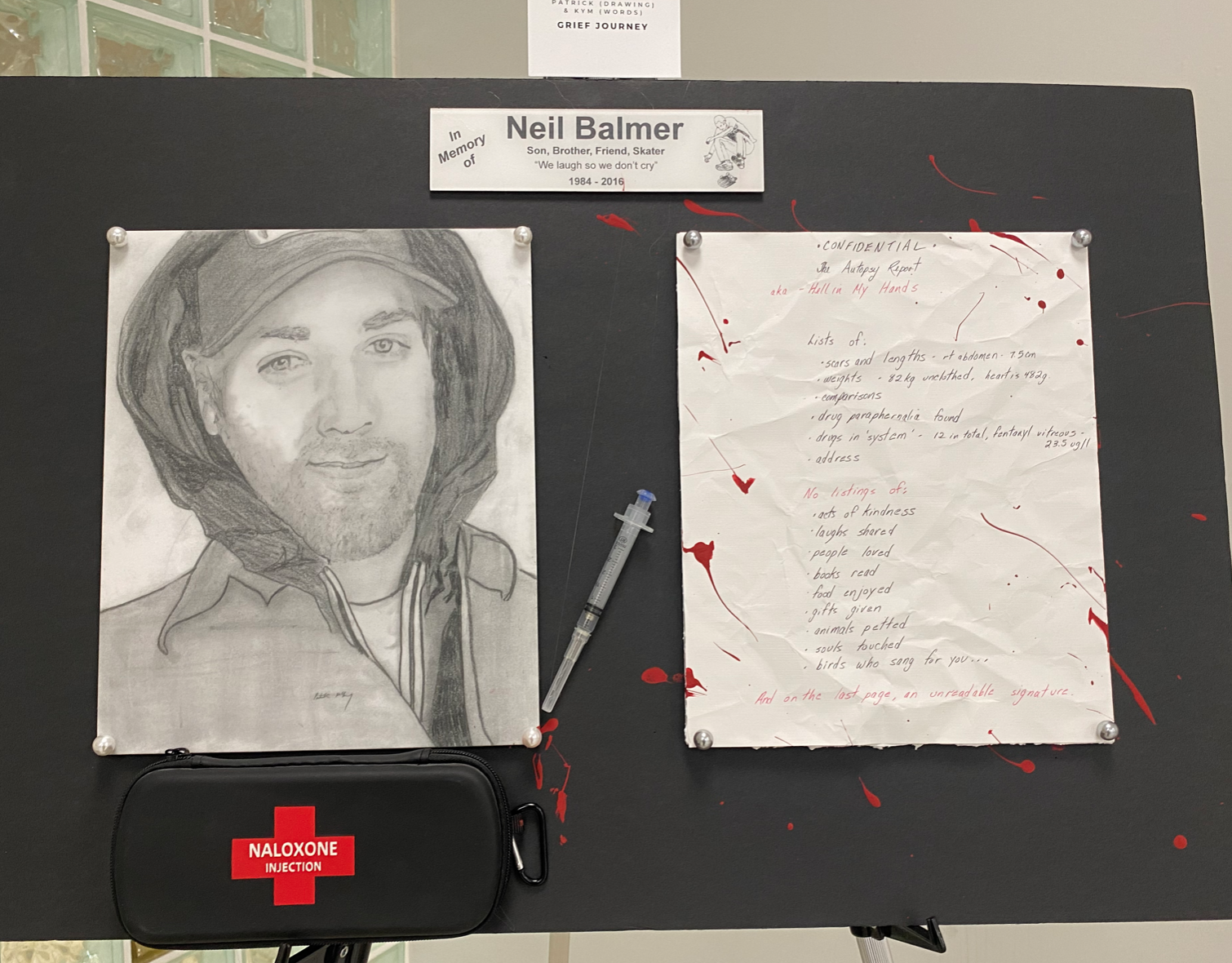
From the Cages: Addiction Awareness Through Art exhibition at MHC, Nov 2025 - file photo
Unfortunately, we do NOT have a Supervised Consumption site in Medicine Hat for substances other than alcohol.
When you do not have a Supervised Consumption site, the entire city becomes an Unsupervised Consumption site.
Having a supervised consumption site is a great way to keep people alive until they can access detox and treatment.
Local advocate Kym Porter lost her son to drug poisoning shortly before he was to enter drug treatment. She is only one of thousands across Canada who have had a similar loss.
Dead People have NO chance of recovery.
Language MATTERS
The language has shifted from “overdose” to “poisoning”. Overdose implies that a person intentionally took too much of a known substance when in fact, people are poisoned by a toxic supply. When you do not know what is in the substance you are using, you cannot know how much is safe to ingest.
The production and sale of alcohol is heavily regulated; consumers know exactly what potency and the ingredients they are getting in each ounce. Nobody ever says someone "overdosed on alcohol", it is always "alcohol poisoning".
Most Drug Poisonings Happen Behind Closed Doors
The public only sees the public drug use, they do not see the drug use that happens behind closed doors or on remote work sites. Many people in the oil patch, construction, trucking and other trades will use cocaine to stay awake for long shifts; cocaine typically cannot be detected on a “piss test" after a few days.
Back before time stamps on receipts and stricter Hours of Service (HOS) regulations for trucking, it was common for truckers to use “go-fast” pills (aka speed) to stay awake. They often ran two or three “Lie Books” (log books) at the same time to maximize miles.
There is a double standard in how society views substance use. An unhoused person using drugs in public is often seen as a problem, a criminal, or a symbol of societal decay.
Housed individuals who engage in similar behaviors get no such condemnation.
The guy leaving a bar who staggers into an alley to pee or vomits on the sidewalk is typically given a pass, seen as just having a bit too much fun.
A city official who once pleaded guilty to drunk driving still has a job.
Same behavior, but one is acceptable and one is not - showing the stigma and discrimination faced by people experiencing houselessness.
A current radio ad features an exchange between a drunk person and a sober one, the sober one says he will be giving the drunk person a ride home. Now imagine if the drunk person was experiencing homelessness.
Did You Know?
About 70% of drug poisonings happen behind closed doors. They happen in homes, in hotels, in emergency shelters, in prisons, jails and remand centres. The stigma of drug use forces your neighbour or your family member to hide their drug use, they often die alone.
Key Takeaways on De-Escalation and Understanding Crisis
A significant portion of the training focused on how to effectively de-escalate situations by understanding the mental state of the person in crisis. The key is to remember that their behaviour is not a personal attack.
"It's Not About You": People are often in crisis when they come to ask for help. In this state, they may not be as polite or respectful as someone who is not in crisis. Service providers should remember that this behaviour is a symptom of their distress and is not a reflection of the provider.
Understanding the Power Dynamic: Service providers are inherently in a position of power over the person seeking help. Being aware of this imbalance is the first step to ensuring interactions are respectful and do not further disempower someone who is already vulnerable.
The Escalated Brain: When a person is in crisis, their brain is in "fight or flight" mode. In this escalated state, the part of the brain responsible for logical thought and risk assessment is essentially offline. This means the person cannot properly assess the situation or their own actions, which explains why they may make choices that seem irrational to others.
The Reality of Sleeping Rough: This constant state of high alert is the everyday reality for people sleeping rough. They almost always operate in fight-or-flight mode because:
They constantly fear for their physical safety.
They fear their belongings will be stolen.
They are often severely sleep-deprived, which profoundly impacts mood and decision-making.
They may be "hangry" – a combination of hungry and angry due to lack of food. Understanding these underlying pressures makes their reactions and heightened emotions much more understandable.
Do Not Demand an Apology: Because an escalated brain cannot think clearly, workers should not demand apologies from people in crisis. Forcing someone in this state to apologize is not only ineffective but can also escalate the situation further. The focus should always be on safety and de-escalation first; the capacity for reflection and apology will only return once the person is calm and regulated.
Practical De-Escalation Strategies and Tools
We learned several practical strategies and things to consider when trying to de-escalate a situation:
Key things to remember:
Set boundaries for yourself and the interaction.
Acknowledge the power you hold in the situation.
Check yourself – be aware of your own emotional state.
Know your triggers so they don't interfere with your work.
Work as a team. If someone else can handle the situation better, let them.
Be aware of the Bystander Effect (people often think someone else will call for help so nobody calls) and be intentional about stepping in or getting help.
Learn the difference between your own discomfort and actual danger.
Maintain good spatial and personal awareness of yourself and the person you're supporting.
The Power of Non-Verbal Communication: We learned that up to 80% of our communication is non-verbal. This includes our body language, where we position ourselves in a room, our tone of voice, and its volume.
Tips for Body Language and Positioning:
Sometimes, simply sharing space in silence can be a powerful way to show you are present and non-threatening.
Keep an open hand stance rather than crossing your arms.
Do not face the person directly. Position your body at an angle, which is less confrontational.
If touch is appropriate and you have consent, a brief touch on the nearest shoulder (the far shoulder requires you to reach across their body, which can feel threatening) is best. Do not put your arm around someone unless you know them very well, and avoid touching their arm, as that can feel too intimate. Always remember, some people do not like being touched at all.
Things That Can Help Calm Someone:
Ask if they are still in danger. They may have just come from a frightening confrontation or altercation, and acknowledging that can help them feel safe.
Give them simple choices. When in crisis, too much information or too many options can be overwhelming. Offering a simple choice, like "Would you like coffee or tea?" can give them a small sense of control.
Humour can be useful, but only if used carefully and appropriately. It should never be at the person's expense.
Avoid telling someone to "calm down." This almost always has the opposite effect and can escalate their frustration.
This is valuable training and can be useful in many places of businesses such as city halls or medical facilities. Many people come in upset - maybe they are upset because they got a cutoff notice for their power and they cannot afford to pay the bill. Maybe someone is in crisis because they saw their loved one get hurt. This can cause an escalated brain. Their manners may go out the window, don’t take it personally.
There will be another opportunity to attend this free training in June.
In the meantime, check out the resources on the Safelink website.
