

New Health Regulations Take Us Back to The Days of Quarantine
New regulation replaces 1985 rules with mandatory quarantine orders for measles, polio, and more. It takes effect September 1.
Back before vaccines were available for childhood diseases such as measles, mumps, whooping cough etc, families were often quarantined until the infection passed. Iron lungs kept polio patients alive, they were often crippled as a result of the disease. The quarantine requirements disappeared when the immunization rates meant that herd immunity was in effect.
Now that our vaccination rates are in the toilet, the quarantine is back.
Alberta's New Disease Powers: What Just Changed?
The province quietly dropped a new regulation on July 30 that replaces the old Communicable Diseases Regulation from 1985. Order in Council #301 Communicable Diseases Regulation
The old regulation from 1985 was written in a different era. It talked about diseases like "pandemic influenza" and "SARS" but left a lot of room for interpretation.
The new one has exact instructions for every single disease.
Under the old rules, a Medical Officer of Health (MOH) had general powers to investigate outbreaks and issue orders. But the new regulation spells out exactly what they can do for each disease, right down to who gets excluded from where and for how long.
Here is what it says about measles
Measles
Investigation
1 The medical officer of health must attempt to determine the source of infection and contacts of the case.
Special measures
2(1) The medical officer of health must, by order,
(a) exclude confirmed and probable cases from all public places until the medical officer of health is satisfied that the cases do not pose a reasonable risk of transmitting the communicable disease to others, and
(b) exclude susceptible contacts of confirmed and probable cases from all public places until the medical officer of health is satisfied that the contacts do not pose a reasonable risk of transmitting the communicable disease to others.
(2) The medical officer of health may, by order,
(a) isolate confirmed or probable cases, including at an appropriate facility, until the medical officer of health is satisfied that the cases do not pose a reasonable risk of transmitting the communicable disease to others,
(b) exclude suspect cases from all public places until the medical officer of health is satisfied that the cases do not pose a reasonable risk of transmitting the communicable disease to others, and
(c) exclude susceptible contacts of suspect cases if there is a high suspicion of measles in the suspect cases until the medical officer of health is satisfied that the contacts do not pose a reasonable risk of transmitting the communicable disease to others.
What "Susceptible" Actually Means and How the Susceptible Get Hit Harder
The new regulation doesn't say "unvaccinated." It uses the word "susceptible". The definition says
Susceptible means to be at risk of infection because the person has not developed protective immunity through appropriate immunization or previous infection, or both.
The old regulation was broader and less detailed. It didn't specifically target contacts of measles cases with the same precision. The new regulation say for measles, Schedule 2 says the MOH shall (not "may") exclude susceptible contacts from all public places, not just school or work.
For an unvaccinated family with kids in school, one measles case in their class means the whole family could be legally confined to their house for weeks.
The Immunity Question
The old regulation treated immunity as more of a general concept. The new one puts the burden on you to prove it. If you claim you had measles in 1995 but have no documentation, you're considered susceptible.
The same goes for vaccination records. If you can't produce your immunization records or a blood test showing antibodies, you're considered susceptible.
Depending on the specific disease, even if you got vaccinated today, it would take anywhere from 2 weeks to several months to become fully immunized and considered 'not susceptible' under this regulation.
Alberta's New Disease Powers: Who Gets Locked Down and Who Doesn't
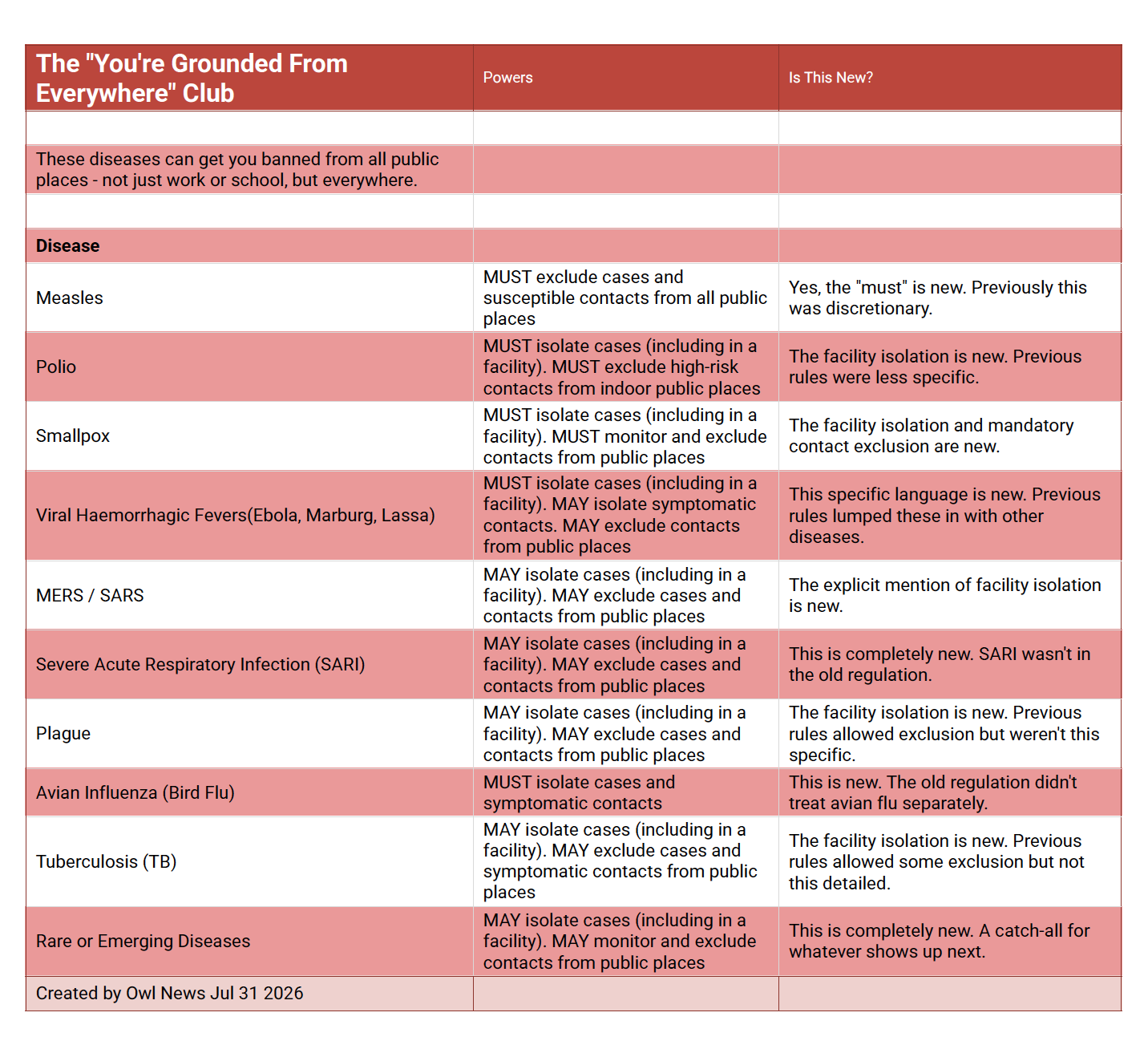
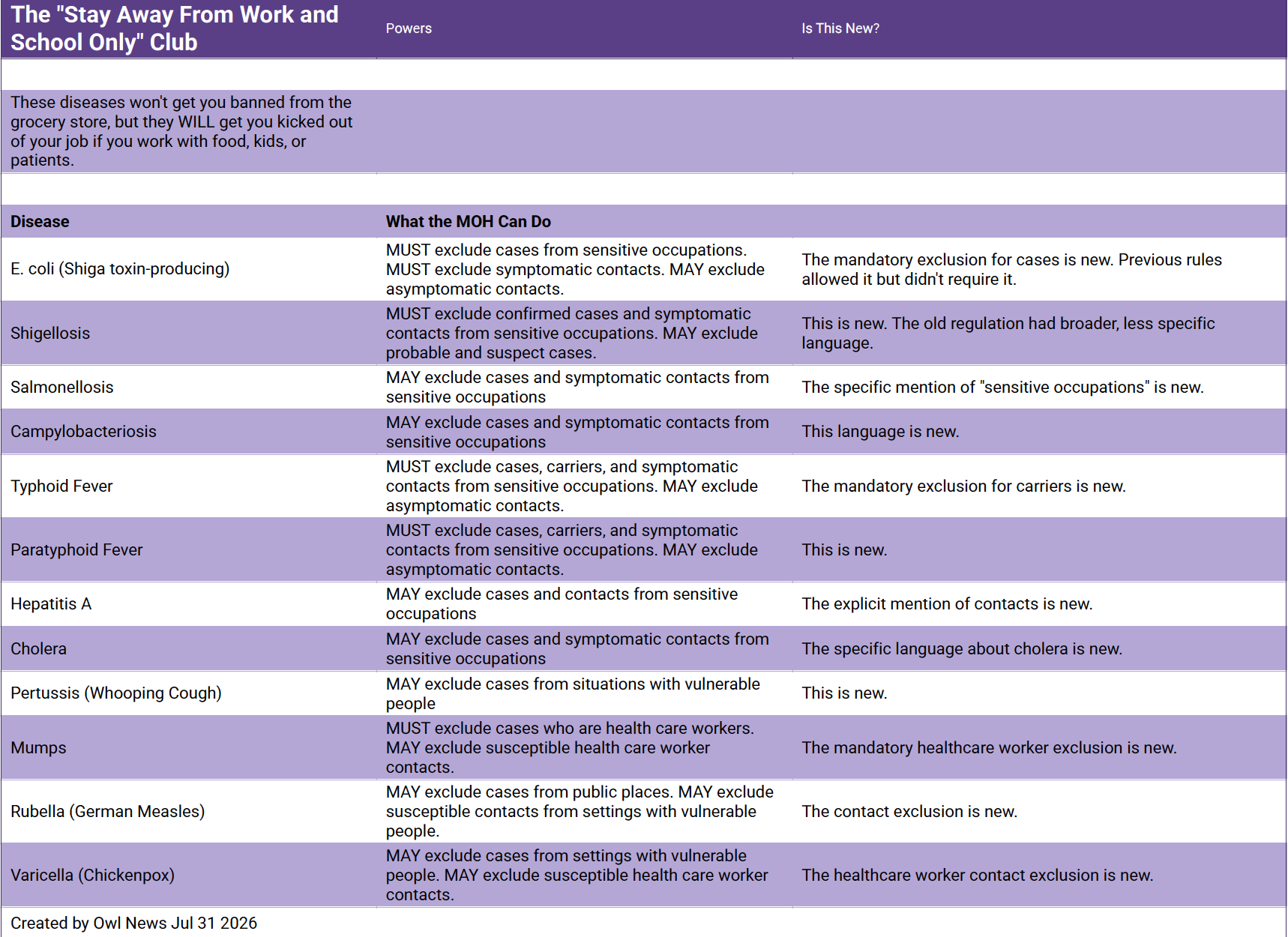
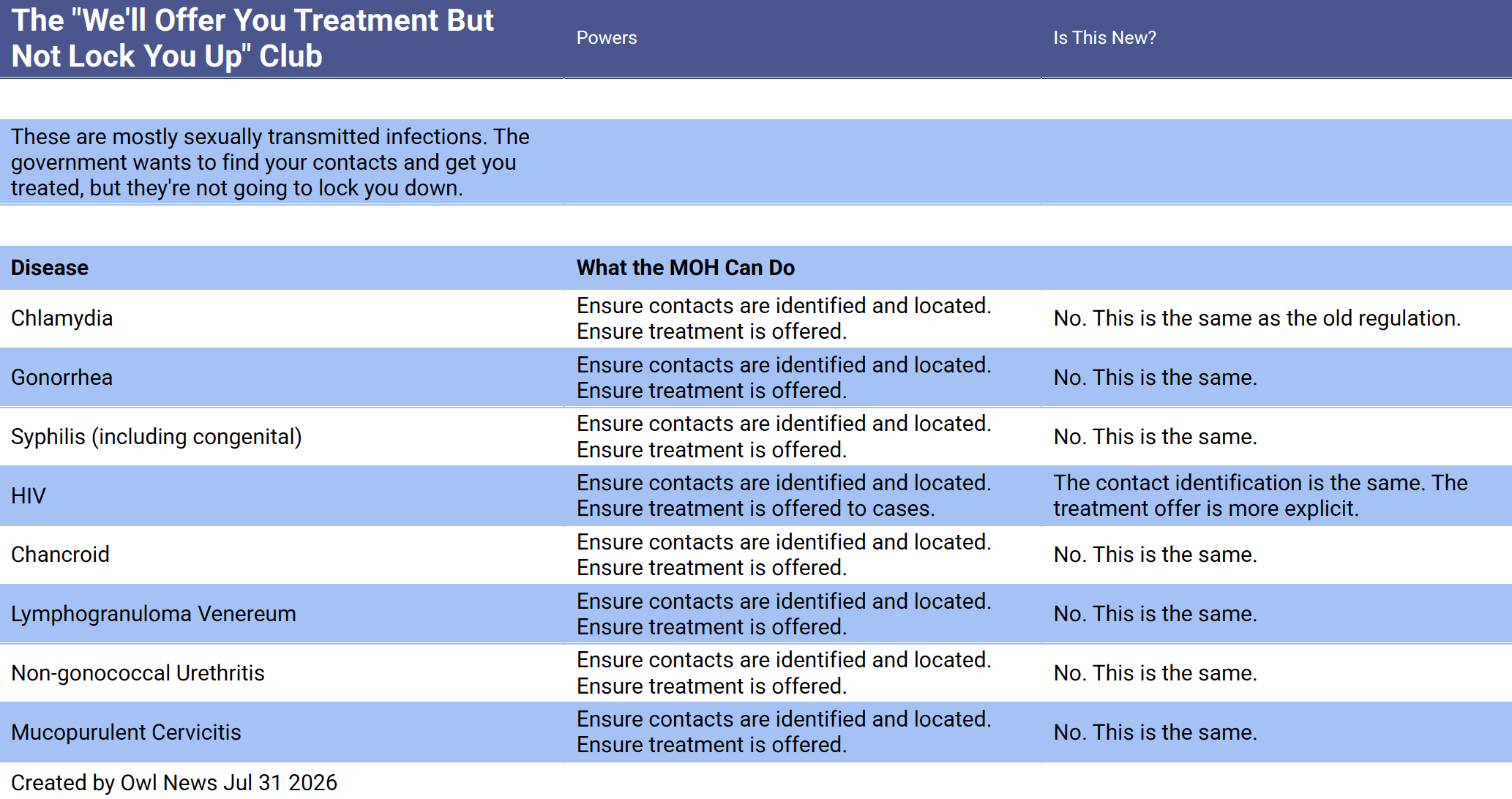
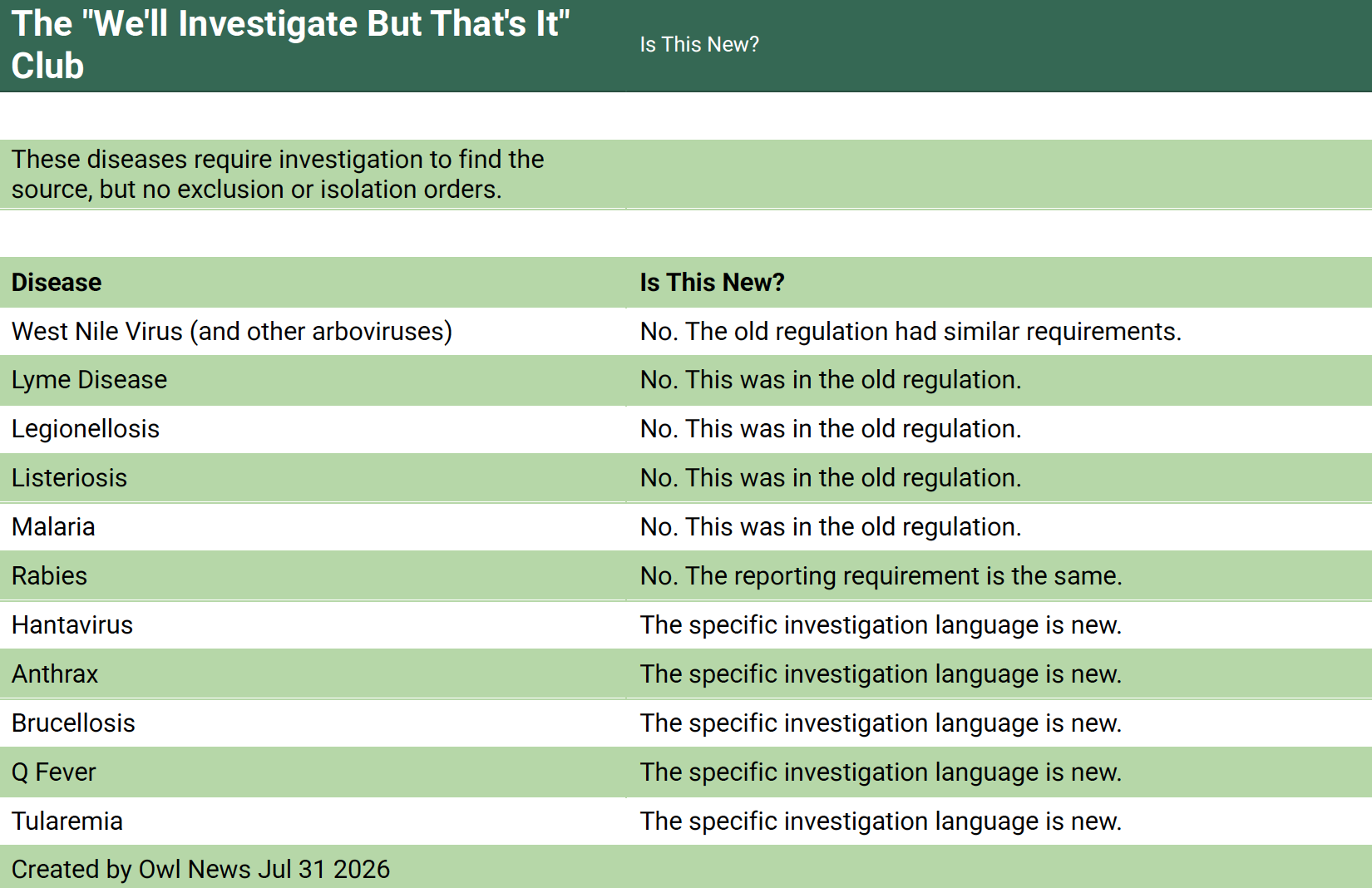
A quick reference guide to the new Communicable Diseases Regulation

Minister of Primary and Preventative Health Services Justin Wright, July 24 2026 - Owl News
The Bottom Line
Most of the really aggressive stuff IS new.
The old regulation from 1985 was vague. It gave MOHs broad powers but didn't spell out exactly when and how they could be used. The new regulation is like a detailed instruction manual that tells them exactly what to do and when.
If you're wondering "could they have done this before?" - the answer is mostly no. They could have done some of it, but not with this level of detail or mandatory language.
The biggest changes are:
Measles is now mandatory. MOHs MUST exclude cases and susceptible contacts. Before, it was up to their judgment.
Facility isolation is spelled out. They can now legally put you in a hospital or quarantine facility for certain diseases. This was technically possible before but never explicitly written like this.
"Rare or emerging" diseases. This is a brand new category that lets the Chief Medical Officer designate any new disease and immediately trigger the strongest powers.
Sensitive occupations are defined. Food handlers, healthcare workers, and childcare staff now have clear rules about when they can be excluded.
The burden of proof is on you. If you can't prove immunity (through vaccination records or blood tests), you're considered susceptible.
Where to Find Your Child's Immunization Status
Alberta residents can check their immunization records through:
MyHealth Records – Online portal through the Alberta government website. You can access your own and your children's immunization records.
Your local public health clinic – They can provide records or advise on what immunizations are due.
Your family doctor or pediatrician – They should have records of immunizations given in their office.
Alberta Health Services Immunization Line – 1-866-301-2668 (toll-free)
If you can't find records – Blood tests (titers) can determine if you or your child have immunity to specific diseases.
For post-secondary students: Check with your college or university health services. Many have immunization requirements for certain programs, especially healthcare-related fields.
What we're asking the minister:
What supports exist for people who lose wages?
Why no mandatory school vaccinations instead?
Why does this come into effect so soon?
etc
We wil publish the ministers answers when received.
