

Code Orange: The Self-Referral Toll Highway to Hell
Full Disclosure - I am the co-chair of the Palliser chapter of Friends of Medicare. I have been involved with them since 2021.
Doctors say this self referral plan will cause a lot of VOMIT
(Victims of Modern Imaging Technology -more on this later).
The reality of the government's new plan to let people buy their own diagnostic scans without a doctor's referral is that the wealthy get a toll lane (with a possible reimbursement) to bypass a gridlocked highway. The rest of us are stuck in an even worse traffic jam. Meanwhile, taxpayers are footing the bill for the detours.
It is a road to hell, paved with good intentions.
The Gridlock in Medicine Hat
We already have underused surgical suites - surgeons are screaming for more OR time but there is not enough staff. There are wards on the 6th floor of the Medicine Hat Regional Hospital that were shut down decades ago and never re-opened - we are using patient lounges as patient rooms, sometimes patients are waiting for days in the ER for an inpatient bed.
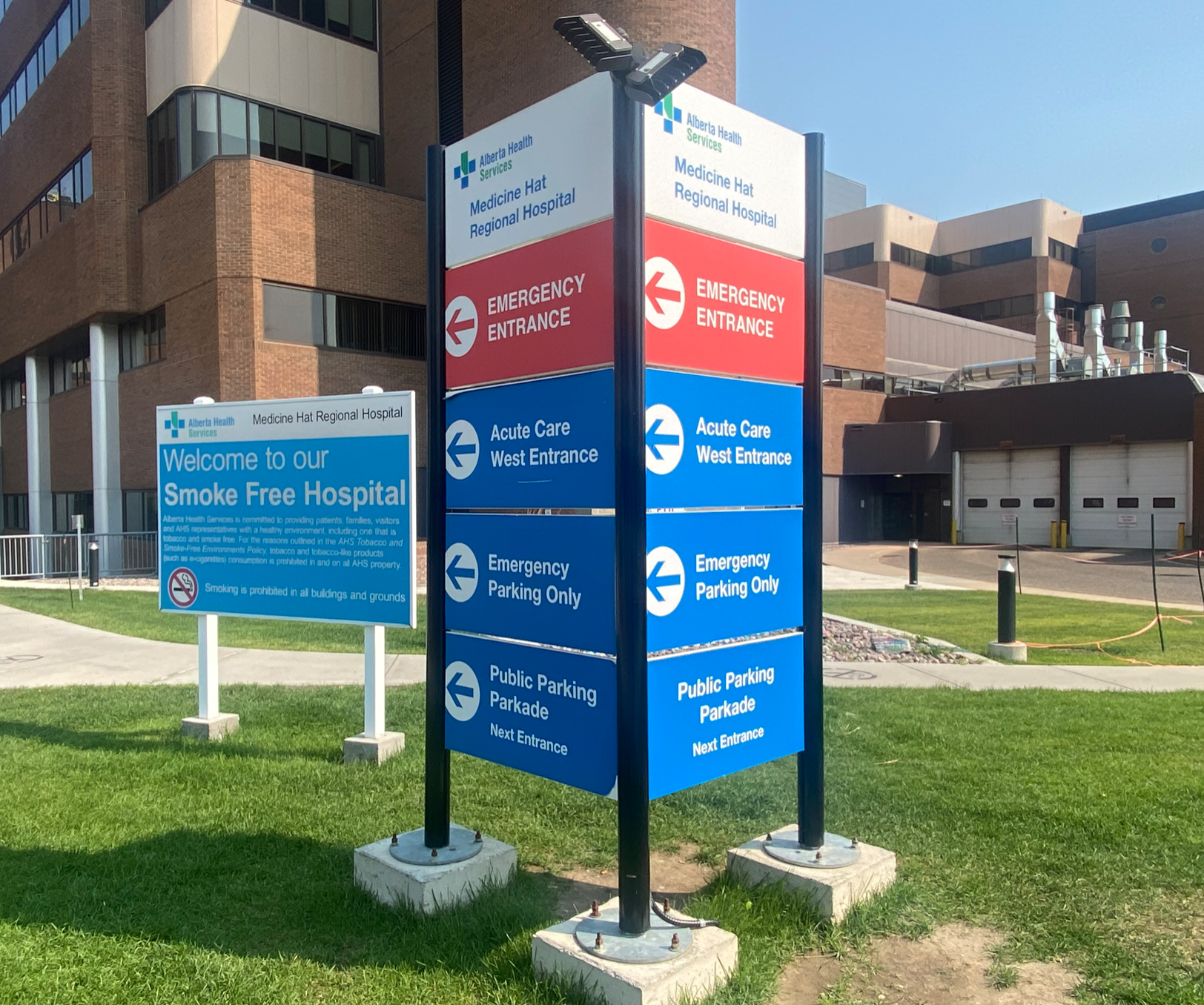
Photo by Kelly Allard
Medicine Hat is currently trying to fill more than a dozen physician positions. They need a pediatrician, emergency doctors, internal medicine specialists, an anesthesiologist, family doctors, and a radiologist - the doctor who reads the scans that affect the course of treatment. This job was posted in November 2025.
You can buy all of the MRI and CT machines but without the technologists to run them and radiologists to read the results, they are just very expensive paperweights.When a private clinic opens, it needs staff. Those staff have to come from somewhere; they will be poached from public hospitals. Why wouldn't they want to work 9 to 5, Monday to Friday, with holidays off and no night shifts? The public system will have fewer people to run the machines and read the scans. There is an international shortage of medical staff.
The Hidden Cost of Unnecessary Scans
The government says this plan is about choice, that it will reduce wait times.
The Alberta Medical Association estimates that every private, self-referred scan that finds something "interesting" will cost the public system an extra $784 and that is just for one finding. A full-body scan can find five, ten, even a dozen things that look suspicious.
A cyst on the kidney.
A spot on the lung.
A clump of blood vessels in the liver.
A bone spur.
A thyroid nodule.
Each one of those findings triggers a cascade of follow-up tests.
A family doctor visit.
A specialist consult.
Another scan.
Maybe a biopsy.
All of it paid for by the public system.
If a scan finds five things, that is nearly $4,000 of taxpayer money spent on investigating things that are almost certainly nothing. If you are in your 60s or 70s, you might have a dozen findings. The cost to the public system could be tens of thousands of dollars per person.
And that is just the cost of the tests. It does not include the cost of the time wasted by doctors, nurses, and technologists who could be treating sick patients instead of chasing shadows.
The Alberta Medical Association estimates that about 3,315 Albertans will pay for private scans each year. That means the follow-up costs will add up to about $911,000 in taxpayer money spent on investigating things that are probably nothing.
The Only Winners
Doctors hate unnecessary testing, calling it VOMIT - Victims of Modern Imaging Technology.
It describes the healthy people who get a scan, find something that looks scary but is actually nothing, and then spend weeks or months in fear and undergoing more tests.
The only winners in this game are the private scanning clinics. They are preying on people's insecurities about their health. They are selling peace of mind that often turns into fear and more medical bills. They are cashing in on the anxiety of an aging population worried they might have to wait in line to get treatment because our medical system has been underfunded for decades.
Now they are offering private scans as a solution to wait times. But scans are useless without the beds, the operating rooms, and the staff to act on the results.
And when that anxiety turns into a "spot" that needs investigating, the public system foots the bill. The clinic gets paid, the patient gets scare, the taxpayer gets stuck with the cost of the follow-up.
A Cautionary Tale
This is not a new problem. A 2017 report from the Canadian Institute for Health Information found that up to 30 per cent of medical care Canadians receive is unnecessary.
The report, which was part of the Choosing Wisely campaign to reduce waste in healthcare, found that Canadians undergo more than a million unnecessary medical tests and treatments every year. It highlighted MRI scans for run-of-the-mill back pain as a prime example. In Alberta, the report found that 30 per cent of patients with back pain underwent at least one X-ray, MRI, or CT scan they probably did not need.
That is one in three scans being done for no good reason. And that was before the government opened the door to self-referred, private-pay scans.
The report also noted that unnecessary care is "baked into" the system.
Doctors order tests out of habit. Hospitals rely on outdated forms that make tests automatic. Patients demand tests because they read something on the internet.
Now imagine adding a profit motive to that mix. Imagine private clinics that make money every time they scan someone, advertising directly to patients and preying on their fears.
The report said that reducing unnecessary scans does not necessarily save money. But it does free up MRI, CT, and X-ray slots for patients who really need them, which should reduce waiting times.
That is exactly what the government claims this plan will do, but the government is not reducing unnecessary scans; they are encouraging them. They are creating a system where healthy people can pay to get scanned, and then the public system pays to investigate the findings. It is the opposite of the Choosing Wisely approach.
The Choosing Wisely campaign worked with doctors to reduce waste. The government is working with private clinics to create more of it.
The Doctors Are Warning Us
The Alberta Medical Association just published a new letter from its president, Dr. Brian Wirzba, about this very plan. It was published on July 29, 2026. Here is what he wrote:
"On Monday, the provincial government announced the next steps for a preventative health testing program that will allow Albertans to self-refer and privately purchase some diagnostic imaging tests, beginning July 31."
He warned that self-referred private-pay testing is not system-neutral. He said, "It creates findings, obligations, costs and follow-up demands that land in the public system, without adding the physicians, staff, equipment or treatment capacity needed to manage them."
He also addressed the claim that this will add capacity. He pointed out that Alberta is introducing this model in a system already facing lengthy imaging waits, workforce pressures, and limited capacity to absorb downstream investigations. He wrote:
"More access to testing does not create more scanners, technologists, radiologists, family physicians, specialists, oncologists, nurses or operating room capacity. It simply generates more findings that the existing system must absorb."
And he echoed the VOMIT problem perfectly. He noted that broad screening of asymptomatic people produces far more incidental findings than clinically significant diagnoses. He cited evidence that up to 94% of asymptomatic individuals undergoing whole-body MRI have at least one detectable abnormality, but true malignancy rates fall between 1.1% and 1.8%. That is a lot of worry for very little benefit.
He also mentioned the hidden costs already discussed. He pointed out that an unneeded scan that picks up an incidental finding can leave a patient with lingering health anxiety and potential issues securing travel, life, or disability insurance, even after the finding is confirmed benign.
His conclusion is a direct warning to the government:
"More testing does not automatically mean better health, and we will speak up when a policy risks overdiagnosis, unnecessary follow-up care and increased pressure on the health system."
The Radiologists Are Opposed
It is not just the AMA. The Canadian Association of Radiologists, the national voice of the doctors who actually read these scans, issued a policy statement in June 2025. They oppose the use of whole-body MRI as a screening tool in asymptomatic individuals.
They say there is no compelling evidence that these scans improve health outcomes or save lives. They warn that they will strain limited imaging capacity, widen health inequities, and displace symptomatic patients.
They also call out the private clinics directly. They say these for-profit imaging centers "capitalize on public fear and consumer desire for control" and that their model is "not sustainable, not equitable, and not evidence based."
The people who actually read the scans are saying no. The government is ignoring them.
The Cost of Stress
Now let us talk about the cost that does not show up on a balance sheet.
Imagine you are a 55-year-old with a family history of cancer. You pay $2,500 for a full-body scan. The clinic calls you and says they found a "spot" on your lung. They tell you it is probably nothing, but you need to follow up with your doctor.
You spend weeks or months worrying. You cannot sleep; you cannot focus, you are terrified that you have cancer. Your blood pressure goes up, your heart races, you are stressed, and stress wreaks havoc on your body.
File Photo Owl News
Then, after a series of tests and consultations, the doctor tells you it was just a harmless nodule. It was always harmless. You spent months in fear for nothing, but the damage is done; the stress has taken its toll. You are more anxious than you were before.
That stress costs the system money too. High blood pressure leads to stroke, heart conditions get worse, anxiety disorders develop. All of these things require treatment, all of them cost the public system more money.
It does not end there. The AMA president also warned that an unneeded scan that picks up an incidental finding can leave a patient with potential issues securing travel, life, or disability insurance, even after the finding is confirmed benign. So you pay for the scan, you stress over the findings, and then you might not be able to get insurance. It is a triple whammy.
The Cost of Waiting
Then there is the cost of waiting.
Every minute a doctor spends reviewing an unnecessary scan is a minute they are not spending on a sick patient. Every appointment a specialist uses to tell a worried healthy person that their "spot" is nothing is an appointment that a cancer patient desperately needs.
For the person waiting in the public system, the cost is even higher. They are waiting in fear. They are waiting for answers. They are waiting for treatment while their cancer grows.
If you are wealthy, you can skip the line. You can get your scan in days, not months. You can get your diagnosis fast. You can start treatment while your cancer is still small.
If you are poor or working class, you wait. You wait for a public scan. You wait for results. You wait for a specialist. And while you wait, your cancer grows. By the time you get treatment, it may be too late.
Two Cancers, Two Timelines
I know about waiting. My late husband Carl had two kinds of cancer. The first was in 1989.
Carl saw the family doctor one day because he found a lump.
A few days later, he saw a specialist who diagnosed the cancer.
The next day, he had surgery to remove it.
Did You Know?
Medicine Hat Hospital got its first CT scanner in 1989; Carl was the very first person on it.
They used him to train the techs, he was on that table for three hours.
The first CT scan was clear.
The second showed the cancer had spread. That was a Wednesday.
On Monday he was in Calgary at the Tom Baker Cancer Centre getting chemo.
Fast forward to 2018 to Carl's second cancer diagnosis.
He could not be referred for treatment until it was staged.
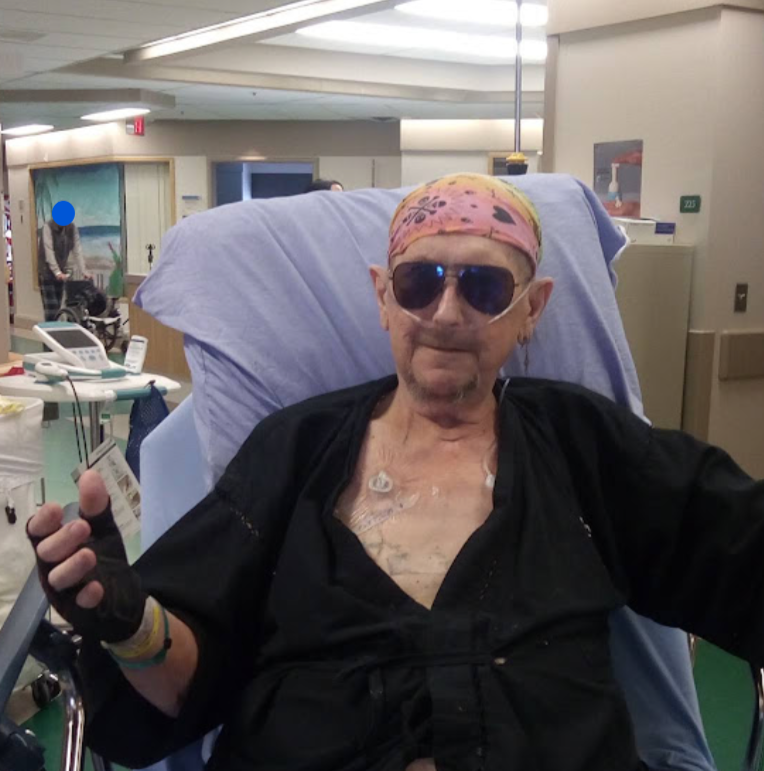
Carl Allard 2019 - photo by Kelly Allard
April 13: First endoscopy after physical issues.
May 3: Follow-up endoscopy with biopsies.
May 15: Third endoscopy. A tumor was found.
May 22: CT scan of chest, abdomen, and pelvis. A PET/CT was recommended.
May 26: Another endoscopy confirmed a tumor.
May 28: CT of the head to rule out metastasis.
June 4: Sent to Calgary for an endoscopic ultrasound for staging.
June 8: Whole-body PET scan. Stage IV cancer.
July 13: First appointment with the local cancer clinic. There was a shortage of oncologists, he had to wait for one to come from Red Deer.
July 20: First treatment.
From the first sign of trouble to his first treatment was over three months.
From the CT scan that first raised concerns about spread, to the PET scan that confirmed it, was three weeks.
From the staging to his first treatment was nearly 6 weeks.
Each test was dependent on the results of the previous test. Every day the cancer was growing.
Diagnosis to death (Oct 2019) was 17 months.
The Voter Frustration
The government should have seen this coming. Our population is aging. Instead of training more doctors, nurses, and technologists, they are selling access to the wealthy even allowing people from outside the province, even outside the country, to come here and self-refer for diagnostic imaging (although they will not get reimbursed).
No other place in Canada allows this to happen.
This plan creates a two-tiered system where the rich get faster care and the rest of us wait and we are told it will make things better for everyone. It reminds me of the George Orwell book, Animal Farm. The pigs in Animal Farm convinced the other animals that the pigs' privileges were actually for their own good.
That is what the government is doing with this plan.
They are selling queue-jumping as a favour to the rest of us.
What To Keep In Mind
This plan starts on July 31, 2026. Before you consider paying for a private scan, talk to your family doctor.
Ask them if the test is right for you.
And ask yourself: is a few hours of peace of mind worth all this risk?
The anxiety you might feel after a false positive could be worse than the worry you have now. The cost to all of us, in tax dollars and longer wait times, is a price we should not have to pay.
The government says this is about choice but it is really about creating a system where the rich get faster care, the clinics make buckets of money and the rest of us wait.
I watched my husband wait for cancer care. I know what that waiting does to a person and a family. I would not wish it on anyone. This plan will make that waiting even longer for the people who can least afford it.
