

Alberta Is Going Backwards on Reconciliation
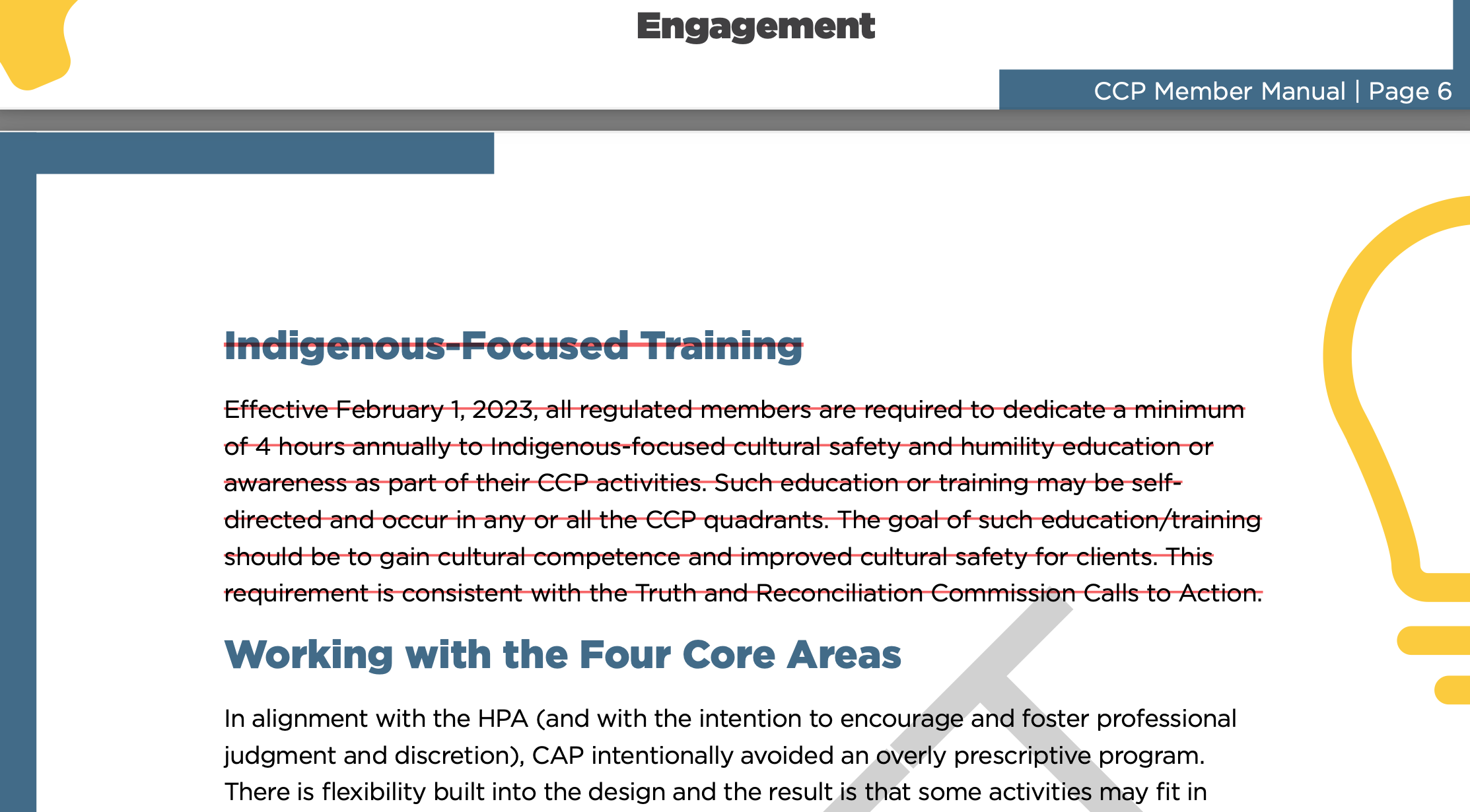
Under a law nicknamed for Jordan Peterson, Alberta is removing mandatory Indigenous cultural safety training for psychologists. Draft documents obtained by the Owl show the strikethroughs.
As Canada marks Truth and Reconciliation Day, provincial legislation is erasing Indigenous cultural safety requirements for psychologists and lawyers.
Yesterday across Canada, people marked Truth and Reconciliation Day. In Medicine Hat, Brenda Mercer, an Indigenous knowledge keeper, artist and the driver behind the White Horse Rider Tepee Project calls it "reconciliACTION". She says it's supposed to be about action, not just words.
Mercer was at the Medicine Hat Public Library yesterday with a bison tooth estimated to be 4,500 to 5,000 years old. It was found during a dig by the water treatment plant. That dig uncovered thousands of items. Only one was left in Medicine Hat - the rest went to Edmonton.
Bison tooth from the water treatment plant dig - estimated age - 4500-5000 years old. - Owl News Photo
That's the local story but there's a bigger story happening in Alberta right now — and critics say it's going in the wrong direction.
A law called Bill 13 is erasing required training about Indigenous history for psychologists, lawyers, and other professionals.
What's being crossed out isn't optional. It's essential.
What's Being Erased
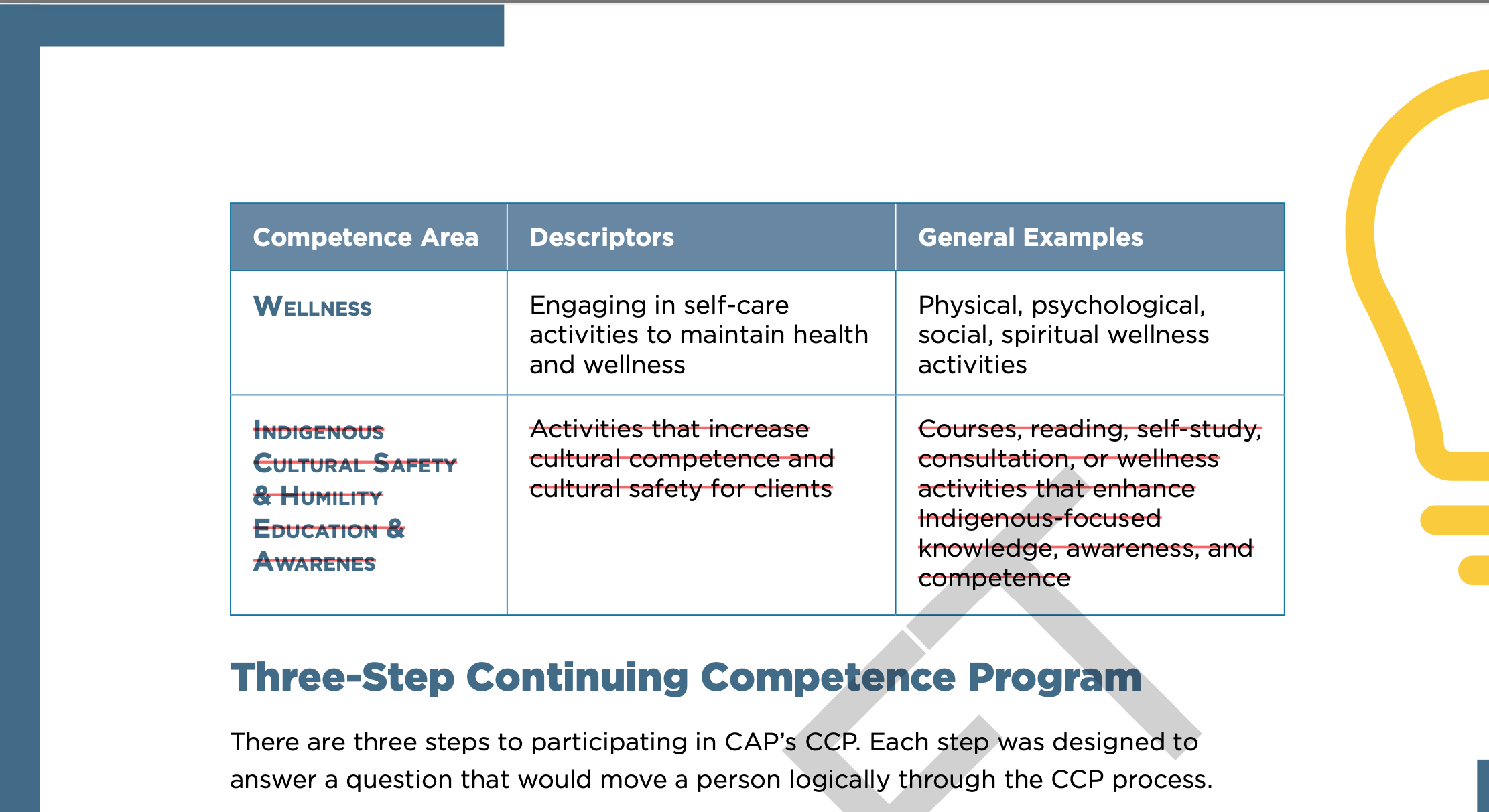
The Medicine Hat Owl has obtained draft documents from the College of Alberta Psychologists (CAP). They show exactly what's being deleted.
"Indigenous-Focused Training" — the entire section is struck out. Previously, every psychologist had to complete 4 hours of Indigenous cultural safety and humility education or awareness each year. The goal was written right in the document: "to gain cultural competence and improved cultural safety for clients. This requirement is consistent with the Truth and Reconciliation Commission Calls to Action."
"Indigenous Cultural Safety & Humility Education and Awareness" as a competence area — the entire row is deleted. In the continuing education program table, this category is gone.
"Injustices suffered by" — struck out. The original standard required psychologists to "familiarize themselves with the current and historical status of injustices suffered by Indigenous peoples." The words "injustices suffered by" have been removed. What's left is just "familiarize themselves with the current and historical status of Indigenous peoples."
"Psychologists shall obtain and maintain cultural competencies" — the entire section is deleted.Section 19.3 used to require psychologists to develop cultural competencies for the individuals and communities they serve. Now it's gone.
In plain terms: Alberta psychologists will no longer be required to learn Indigenous history. No longer required to understand what happened in residential schools. No longer required to develop any cultural competence at all.
What Residential Schools Actually Did
Some might ask: so what if they don't learn history? Is it really that serious?
Residential schools were not ordinary boarding schools. The Owl spoke with one person who attended a boarding school in the UK. He said he went to a boarding school and he turned out fine.
The Owl asked him:
Were you ripped from your parents' arms?
Were you punished for speaking your own language?
Did your parents have a choice to send you there?
He had to admit: it was different.
Children in residential schools were taken by force. From their parents, from their communities, under the authority of law. Their languages were banned. Their cultures were called inferior. Their hair was cut. Their names were changed.
Many children were physically harmed. Beaten, sexually assaulted, locked in confinement. Some died. The Truth and Reconciliation Commission confirmed over 3,200 deaths, but the real number is likely much higher — because records are incomplete, and some were destroyed.
Many who survived never learned how to be parents. They grew up in institutions, taught that their culture was wrong. No one taught them how to care for children, how to build a family. That damage passed to their children, and to their grandchildren.
The harm is generational and causes struggles with trauma, addiction, and family breakdown. We hear stories of healing from those who embraced their culture and started dancing or beading or studying their heritage.
While People Are Mocking This
Just last month, a white nationalist group called "Second Sons Canada" hung a banner near the former Kamloops residential school site. It read: "Got bones?"
Chief Rosanne Casimir of Tk'emlúps te Secwépemc said the community had to hire 24-hour security because "somebody showed up with a shovel" to dig on the site themselves. The community has said it needs to protect the site while it works through a community-led process to determine next steps.
In Alberta's referendum, one question asks whether to ban refugee children from public schools. A longtime Conservative strategist named Ken Boessenkool called the nine referendum questions "a mix of the racist and the useless."
Senator Paula Simons wrote: these nine questions "are deliberately designed to incite social division."
In this atmosphere, the Alberta government says: psychologists don't need to learn Indigenous history anymore.
Why the Requirements Existed
The Indigenous-focused training requirements were not imposed arbitrarily. They were built over years in direct response to the Truth and Reconciliation Commission's Calls to Action.
CAP's own records show the timeline. In 2018, CAP and the Psychologists' Association of Alberta established a joint Truth and Reconciliation Task Force. In 2019, CAP established two new Standards of Practice: one titled "Recognizing the Truth and Reconciliation Commission's Calls to Action" and another prohibiting conversion therapy. In 2021, CAP issued a practice guideline titled "Working with Indigenous Populations and Communities: A Guide to Culturally Safe Practice and Humility".
The mandatory continuing education requirement came in 2022. That year, CAP implemented a requirement for all regulated members to complete four hours of Indigenous-focused cultural safety and humility education as part of their Continuing Competence Program . The following year, CAP entered a Memorandum of Understanding with Siksika Health Services to support the TRC's Calls to Action, signed with traditional ceremony .
The Law Society of Alberta followed a similar path. It made "The Path: Your Journey Through Indigenous Canada" mandatory for new lawyers in 2021. The requirement survived multiple challenges, including a 2023 referendum in which 75 percent of voting lawyers voted to keep it mandatory, and a subsequent lawsuit .
That is what Bill 13 undoes.
What Remains
Bill 13 does not make cultural competency training illegal. It makes it voluntary.
The Law Society confirmed that "The Path" will remain available to Alberta lawyers at no cost. They simply cannot be required to take it. CAP's own fact sheet states that "Voluntary programs can still be recognized in continuing competence programs."
The problem, critics say, is that voluntary systems tend to reach the motivated. The lawyers who voted 75 percent in favour of keeping the mandatory course were the ones who valued it. The psychologists who took the four hours seriously were the ones who already understood why it mattered. The people most likely to cause harm through ignorance are often the least likely to seek out the training on their own.
As one Indigenous psychologist wrote in the Psychologists' Association of Alberta newsletter: "There have been only 11 Calls to Action completed out of 94."
What's Happening in Medicine Hat
This isn't just an abstract debate. It's happening here.
As the Owl's Alex McCuaig has reported extensively, Medicine Hat's history stretches back thousands of years — but that history is not mainly recorded in written words. It's recorded through oral traditions and the artifacts left behind in the earth (read more).
In 2023, construction at the Medicine Hat water treatment plant uncovered a site dating back more than 1,000 years. The province confirmed "two deeply buried ancient Indigenous campsites, including evidence of bison bone processing and stone tool production activities that date to approximately 1,100 to 1,500 years ago" (read more).
Thousands of items were found. Only one stayed in Medicine Hat. The rest went to Edmonton.
But the local Indigenous community wasn't notified, they weren't even told the site was Indigenous in nature until the contractor presented its findings publicly — nearly a year after the excavation was complete. Brenda Mercer told The Owl at that time that she just wanted the city to retrieve some of the items removed from Medicine Hat. "Truth and Reconciliation is so important right now and let's put some action into these words today and let's get some pieces back here," she told the Owl. "Three little pieces at the start. That's all we're asking for." (read more)
The city's record on Indigenous recognition is mixed.
It launched an Ancestors Reburial Project in 2023. It designated a spot at Police Point Park for Indigenous activities — though that park is named for the NWMP, who were only there briefly, and nobody seems to know the area's original name. It added a dance floor at the Saamis Tepee. Saratoga Park has a plaque. Yesterday the Medicine Hat Public Library announced funding for Indigenous content at the library.
Chief Librarian Ken Feser, Elder Charlie Fox, Brenda Mercer Sept 30 - Owl News
But there is nothing at the original site in Ross Glen, a 5,000-year-old stone circle site once described in a provincial report as "one of the most significant... yet investigated in Alberta and possibly in all of the Northern Plains." Most streets are named after old white men. Public Indigenous art is scarce.
Rob Desmarais, a Hatter who has traced his family's history to the Sioux of Standing Rock, has been advocating for the return of remains removed during archaeological digs in the 1960s. As McCuaig reported, Desmarais remembers as a kid seeing foxes dig up human bones on Scholten Hill.
"I remember as a kid these foxes dug femurs up - human body bones - and I always shoved them back in the hole," he said.
He said the biggest injustice is that the remains were removed in the first place.
"They dug them up and put them on shelves. That's totally wrong. Let the poor people rest," he said.
"As a city, they can do a lot more," he said. "It was a major deal here and the city could have done more."
If it was up to him, Desmarais said a centre depicting the city's Indigenous history should be established because, "the younger generations are going to want to know about it."
Why This Is Especially Dangerous
Psychologists are not like other professions. People go to psychologists when they are at their most vulnerable. Depression. Anxiety. Trauma. Domestic violence. Addiction.
A psychologist who doesn't understand intergenerational trauma — who doesn't know that a client's addiction might connect to a grandmother's residential school experience — can't treat the whole person. They might see symptoms without understanding the cause. They might blame the individual for what was done to their family.
The College of Alberta Psychologists itself acknowledged this. In its own fact sheet, it said the Truth and Reconciliation Commission's Calls to Action include providing "cultural competency training for all healthcare professionals."
CAP knew this. Now it's being forced to erase it.
The Law Society of Alberta, which regulates lawyers, had to do the same thing. Its president, Bud Melnyk, said the legislation "does not allow regulators to offer culturally specific programming whatsoever." They cancelled their mandatory Indigenous course. They dissolved their Indigenous mentorship programs.
The Message This Sends
When a province removes required Indigenous history training from psychologists, lawyers, and other professionals, what message does that send?
Critics say
it says: this history doesn't matter.
It says: the people who suffered don't matter.
It says: reconciliation was a nice idea, but it's time to move on.
But you can't "move on" from something that's still happening. The trauma is still here. The racism is still here. The denialism is still here — and critics say it's getting louder.
A psychologist who denies residential school harms, or who simply doesn't know about them, can't serve Indigenous clients well. And under Bill 13, the College of Alberta Psychologists can't even discipline that psychologist for public denialism, because the law protects "expressive conduct outside practice."
So what happens when an Indigenous client sits across from a psychologist who doesn't believe their grandmother's trauma was real?
What Reconciliation Actually Requires
Real reconciliation isn't a holiday. It isn't a land acknowledgment. It isn't a nice speech once a year.
The Truth and Reconciliation Commission's own framing emphasizes that reconciliation is "more than an apology; it is about structural change, accountability, and co-creation."
Alberta is doing the opposite. It is removing the structures that were built in response to the Truth and Reconciliation Commission. It is telling professionals: you don't need to know this. It is telling Indigenous communities: your history is optional.
As an Indigenous psychologist wrote in the Psychologists' Association of Alberta newsletter: "There have been only 11 Calls to Action completed out of 94."
Eleven out of ninety-four.
And now, Alberta is taking steps backward from even those eleven.
