

Medicine Hat, A Crossroads Of Indigenous Culture That Struggles With Recognizing Its History
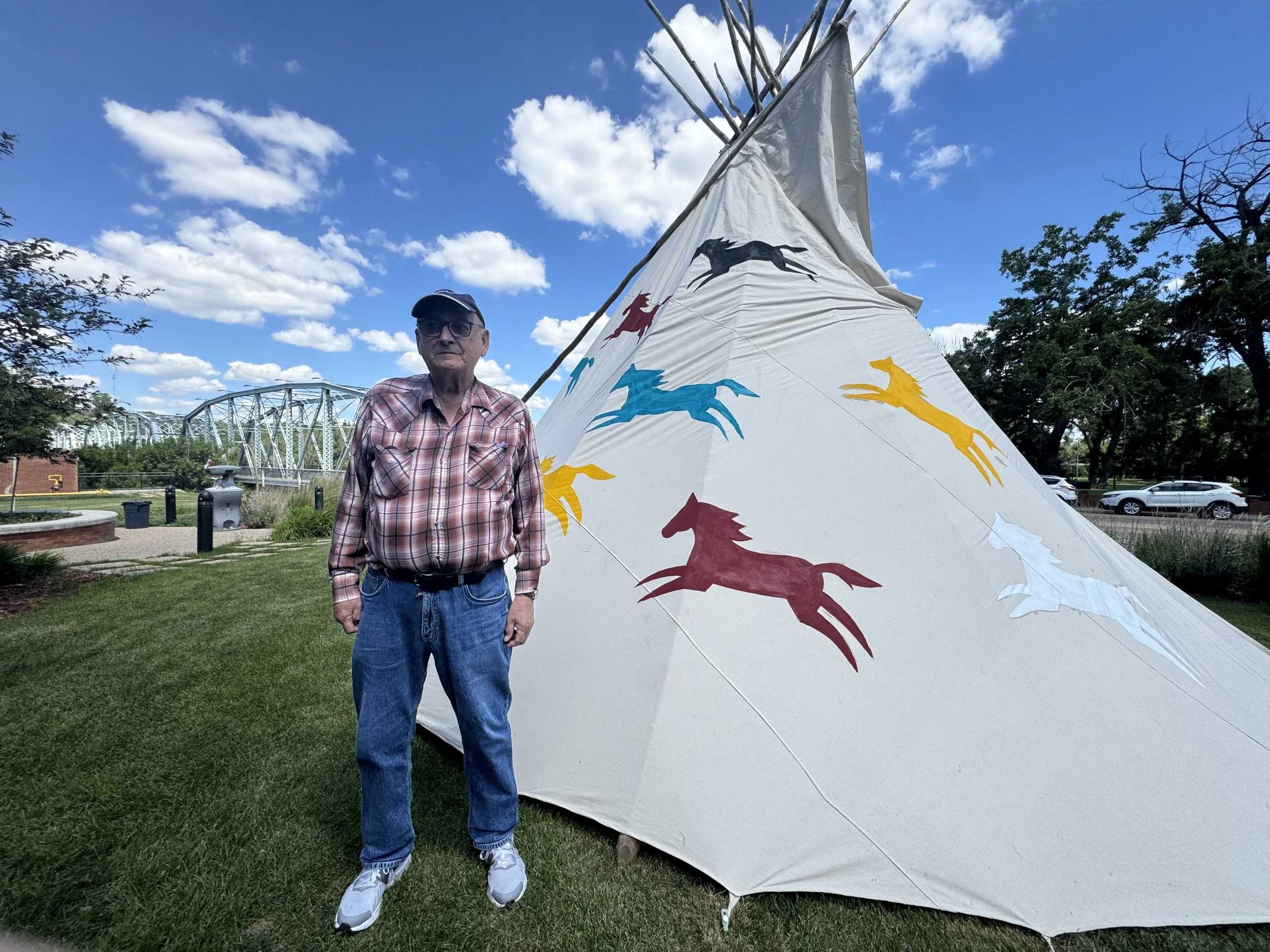
Rob Desmarais stands next to a teepee set up outside City Hall on Friday during Medicine Hat’s National Indigenous Peoples Day ceremony. Desmarais has been advocating for the repatriation of Indigenous remains from the “Indian Cemetery” which is located along Scholten Hill. (Photo Alex McCuaig)
Medicine Hat’s vast history stretching back thousands of years is not one which is mainly recorded in written words but through the oral traditions of those who first called the area home and the artifacts left behind in the earth.
While the written history of the city is one which is often celebrated, it represents a sliver of time amounting to not much more than a century-and-a-half compared to the millennia of human occupation of the area.
Habitation of the Ross Glen neighbourhood didn’t start when the sub-division was being developed in the early 1980s but more than 5,000 years earlier, according to radio-carbon dating of artefacts uncovered in the neighbourhood.
Today Ross Glen could be viewed as a run-of-the-mill sub-division, common for its era in any city across the continent. But according to a provincial archaeological report conducted prior to construction of the neighbourhood, it’s built on “one of the most significant stone circle sites yet investigated in Alberta and possibly in all of the Northern Plains.”
Yet, the civil defence siren from the 1950s located on the Southeast Hill has a higher rated historic significance in the city than a local habitation site which dates to the beginning of the Bronze Age in Europe.
Medicine Hat’s former Saratoga Park area represents a transition of history as we know it in the city. The way history is told, who is telling it, changes in how people went from moving by foot and living by following bison herds to travelling cross-country by rail and residing in houses along with whose voices mattered.
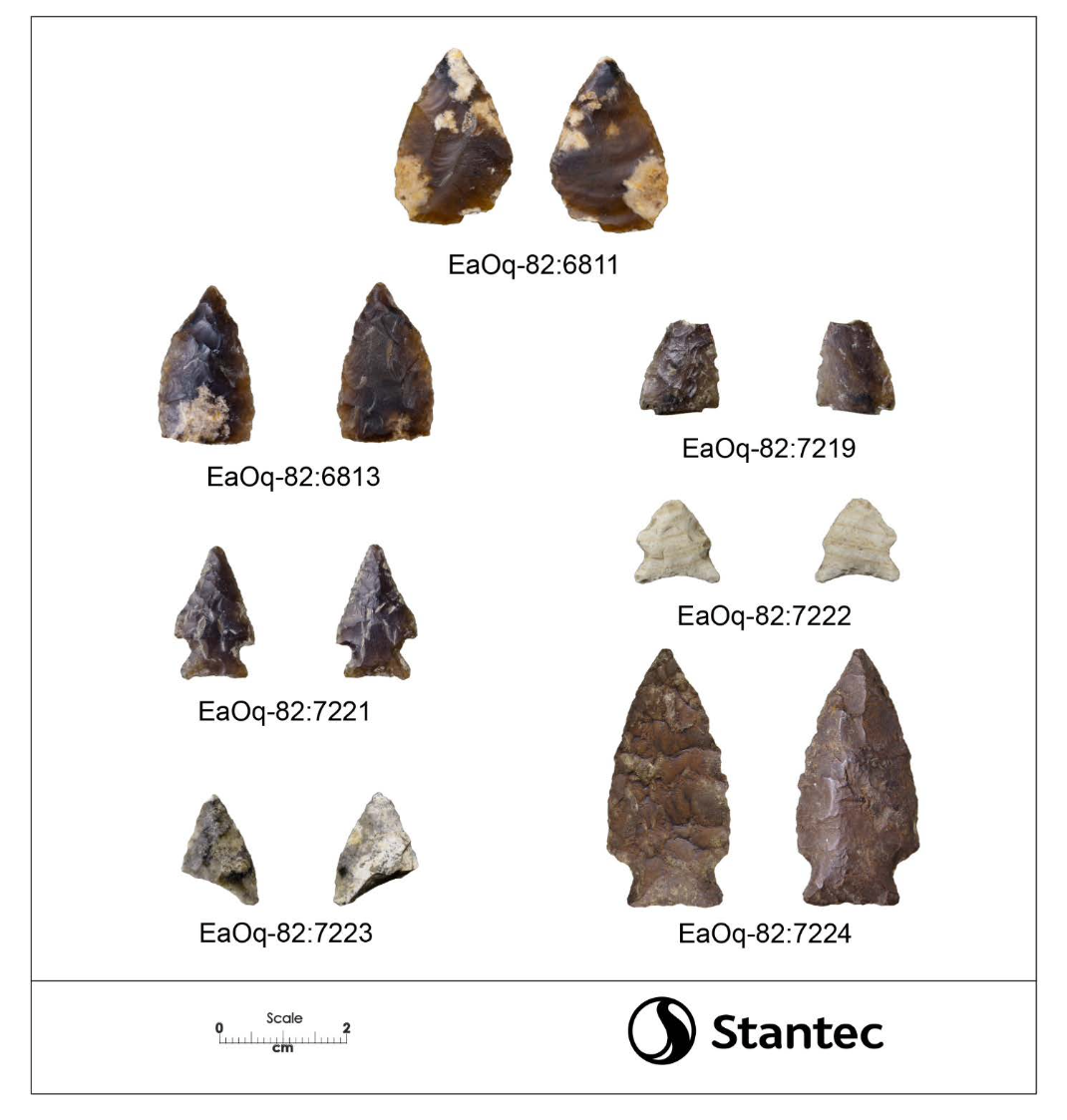
Broken projectile points (EaOq-82:6811, 6813, 7219, 7223), Samantha/Avonlea arrow points (EaOq-82:7221, 7222) and a Besant dart point (EaOq-82:7224) recovered from the excavation site at the city’s water treatment facility. (Photo courtesy of Stantec)
Sitting near the confluence of the South Saskatchewan River and Ross as well as Seven Persons creeks, what is known as Saratoga Park would have been an attractive spot for anyone moving through the region over thousands of years. It would be a draw for its open water in the winter along with game, medicinal plants, firewood and even a clay deposit for pottery made hundreds of years before Medalta or Hycroft could even possibly be envisioned.
“It’s history,” said Hatter Rob Desmarais who was born in Saratoga Park in 1947.
And it’s a historical connection to the city and region as a whole that is a personal one for Desmarais.
While Desmarais holds Metis status, his descendants can be traced to the Sioux of the Standing Rock Reservation in the Dakotas.
And without the strict border controls which now exist, there was a lot of movement across the US-Canada boundary with Desmarais saying over the last half of the 19th century, his Sioux ancestors were moving west and north into Saskatchewan with his family, in particular, settling within the Cypress Hills and then Medicine Hat.
“They hung a bunch in Minnesota so I surmise some of them were running for their lives. That’s my opinion,” said Desmarais, referencing the nearly 40 Sioux killed in 1862, believed to be the largest mass execution in US history.
Desmarais said, “it took me a lifetime,” to trace his families history. Much of that history is well documented through his research which includes the birth, death and baptism records dating from the late 19th century in and around Medicine Hat.
Much of the written history dates settlement of Saratoga Park, and the adjacent area north of the CPR line referred to as Moccasin Flats, to the early 20th century. But Desmarais questioned how settlement of that area couldn’t have been earlier.
“They had to be here some place. They never had no houses to live in. They were indians,” he said of his family which he has traced through documented historical record searches to Medicine Hat. “They had to have lived down there some place. . .My dad and them, we know where they lived, but the grandparents, where in the hell did they live?”
Excavations which have taken place along the Seven Persons Creek have, and continue to, reveal a well utilized Indigenous site with bison bones easily found throughout Kin Coulee.
A recent excavation at the water treatment plant by the Trans-Canada Highway revealed a millennia old camp site denoting an important technological transition of Indigenous peoples from atlatl spears to bows and arrows.
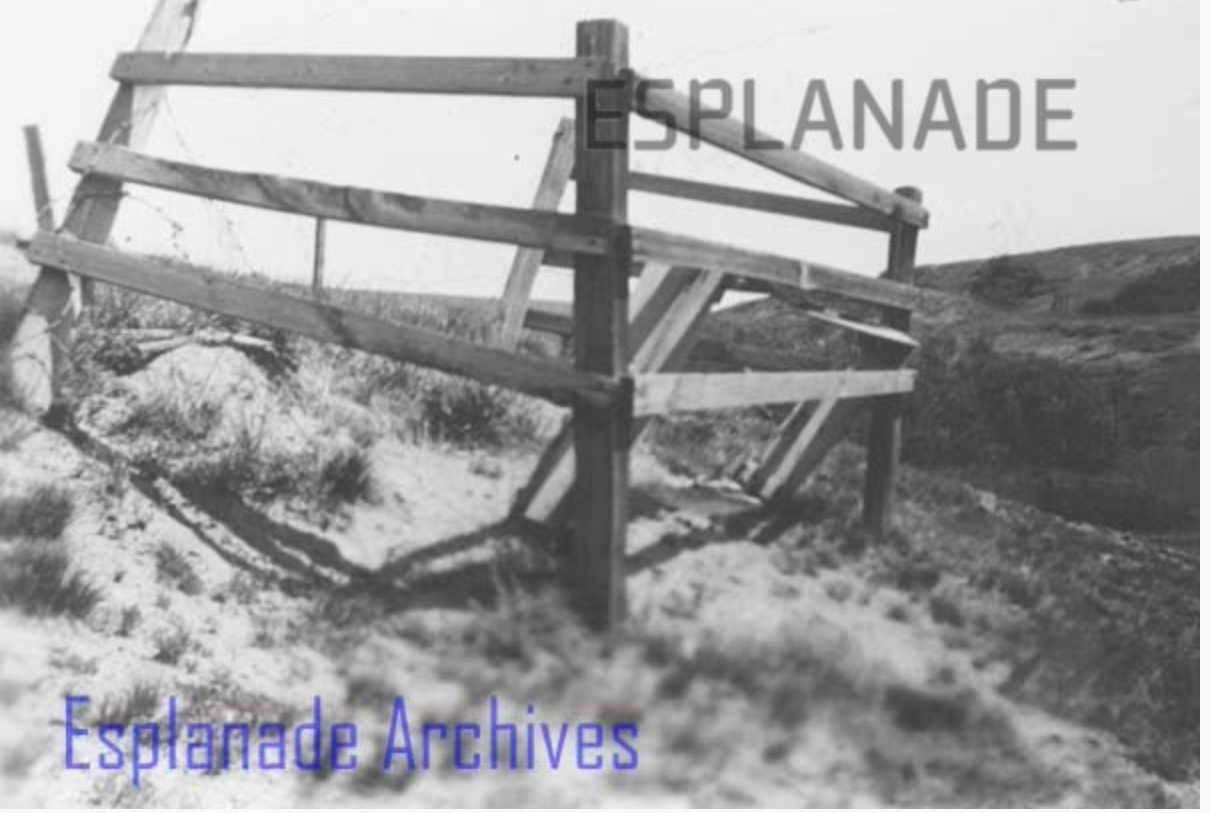
One of the marked Indigenous grave sites which dotted Scholten Hill during the early part of the 20th century.
Desmarais’ tracing of his family’s history puts his ancestors in the Cypress Hills during the time Cree Chief Poundmaker was residing there and overlapping the period which saw Sitting Bull living there as well.
Following the Battle of Little Bighorn and the defeat and killing of the US Cavalry’s Col. George Custer in 1876, Sitting Bull sought and was granted protection by one of the original Mounties, James Walsh.
Desmarais said some of his family were born in the Cypress Hills near the same time as Sitting Bull was seeking refuge and just prior to his eventual surrender and return to the Standing Rock Reservation.
The Cypress Hills also hosted Foremost Man (Neekaneet) during that time, a chief who fought for a reservation at the site despite Parliament declaring in 1882 that those living in the hills were to be expelled. That fight would eventually lead to the creation of the Nekaneet First Nation in 1913 near Maple Creek, Sask.
And in 1873, members of the Assinaboia Carry The Kettle Band were killed during the Cypress Hills Massacre near Battle Creek, a major impetus in the creation of the North-West Mounted Police which built Fort Walsh near the site were 20 members of the tribe were killed.
Adding to the cultural mosaic of the Medicine Hat region is the Blackfoot whose language the city takes its name from along with many oral history legends. But the city itself stradles that nation’s Treaty 7 territory and the Cree and Sioux’s Treaty 4’s roughly divided by the South Saskatchewan River.
But while there is no doubt of there being a tapestry of different First Nations cultures living in and around the city, it’s where they died which has become an issue in the contemporary context.

Along Scholten Hill and sitting above Saratoga Park lies what was called during the late-18th and early 19th-century the “Indian Cemetery.”
There was even an eyewitness account written of an indigenous child’s traditional funeral at the site dating from the Medicine Hat News in 1900. There are also both written and oral historical accounts of the remains of those who were left above ground in accordance with the traditions of the Indigenous groups they belonged to also being reinterred at the site.
In an article dating from 1911, the News wrote of the discovery of what was described as an “indian warrior” which was uncovered during foundation work for a new home with the article noting the man was buried with a hawk’s talon, string of beads and a “quaintly made saddle.”
The article indicated the remains would be interned at the “Indian Cemetery.”
These graves at the unofficial cemetery were marked by rough-hewn wooden fences, at least up until 1935.
But within a couple of decades those gravesites were largely forgotten about by city officials.
It was, however, hard to ignore the human remains which continually became uncovered along the hillside.
By the 1950s, it was becoming a regular occurrence with then legendary Saratoga Park resident Bill Bliss being quoted as explaining the hillside was utilized as a burial site by “stone boilers,” a term used to describe Assinabioa as well as Sioux. The term - sometimes simply refered to as stoney or stone people - is based on their cooking technique of using red hot stones for boiling.
It’s a story Desmarais said Bliss recounted to him as well and describing the man as extremely intelligent.
Despite a number of accounts of recovery of human remains in the area of Scholten Hill, little is known what happened to them.
Desmarais said he would personally come across holes dug by animals with human remains being discharged during the digging.
“I remember as a kid these foxes dug femurs up - human body bones - and I always shoved them back in the hole,” he said.
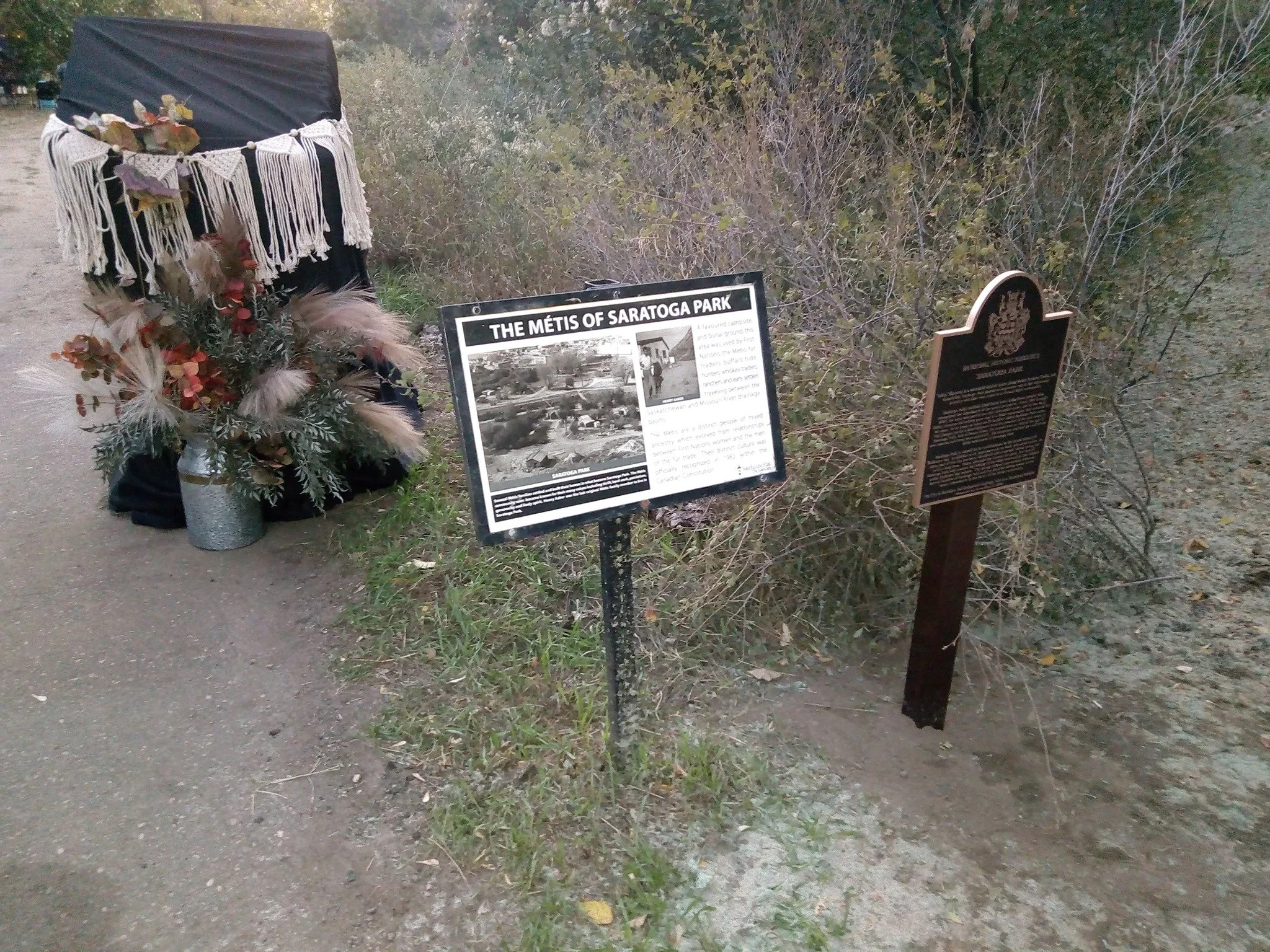
The plaque and story board currently denoting Saratoga Park. (File Photo)
By the late-1960s, University of Alberta archeologists visited the site after more human remains emerged due to badger activity. That excavation led to the documentation and the recovery of three Indigenous individuals, a woman and two children.
Nearly a decade ago, Desmarais began advocating to the municipal government to have the remains brought back to Medicine Hat from the University of Alberta to be reburied in the city.
It’s been part of the culmination of Desmarais’s years research into his past and one which has lead him to the conclusion some of those interned are likely his relatives.
After some false starts repatriating the remains, work began in earnest in 2022 with the city launching its Ancestors Reburial Project.
But the journey back to Medicine Hat for the remains of the Indigenous woman and two children has not been an easy one.
As the city is crossroads of Indigenous cultures, it’s far from certain which First Nations the remains belonged to with protocol dictating a collaborative approach amongst different groups at to how to repatriate the individuals.

Relations between the Blackfoot and Sioux along with the Cree have historically involved bad blood between them, said Desmarais, adding, “that’s just a fact.”
But despite past animosity, he described Blackfoot as “cousins” and the remains from the Ancestors Reburial Project would be relatives of both.
“For me, it’s to keep a good faith on it because we’re all related,” said Desmarais of the effort to repatriate the remains. “We’re all on the same turf here.”
But there are some lingering disputes regarding just where the historic land boundaries are and who has a say in determining how repatriation is to occur.
That became all too apparent last summer when a repatriation ceremony was just hours from taking place at the Medicine Hat Cemetery of the three Indigenous individuals held by the University of Alberta.
That ceremony was stopped in its tracks by objections by the Carry the Kettle Band over what was being planned.
Desmarais said the remains shouldn’t have been taken in the first place.
And he was critical of the city’s hiring of Indigenous consultants from not just outside Medicine Hat but from different provinces.
“I always thought it was unjust,” he said, later adding, “they are doing it wrong.”
But he said the biggest injustice is that the Indigenous remains on Scholten Hill were removed in the first place.
“They dug them up and put them on shelves. That’s totally wrong. Let the poor people rest,” he said.
Desmarais said he did have discussions with an individual who suggested utilizing ground penetrating radar to locate gravesites along Scholten Hillbut his stance is that nothing of the sort should take place.
“I told him don’t. Let these people rest. What are you going to do with them? Dig them up and put them on selves too?”
Asked what he’d like to see done to the Scholten Hill burial grounds, Desmarais became choked up.
“Most of the bodies they find, they always end up in some university’s shelve. It’s not appropriate.”
One of the criticisms Desmarais has is the lack of detailed descriptions of the people of Saratoga Park that are presented by city officials when talking of the settlement.
A plaque just isn’t enough recognition of an area of such importance to the history of Medicine Hat.
“I thought they would have done more,” said Desmarais. “More should be done than a little plague on a trail.”
To that end, he said there should be some federal recognition of the Saratoga Park and Scholten Hill sites.
Desmarais said there is archaeological evidence of massive Indigenous camps around Medicine Hat that were used at different times over centuries and there are likely many burial sites along the hills of the municipality.
“As a city, they can do a lot more,” he said of recognition of Indigenous sites. “It was a major deal here and the city could have done more.”
If it was up to him, Desmarais said a centre depicting the city’s Indigenous history should be established because, “the younger generations are going to want to know about it.”
For it’s part, Mayor Linnsie Clark said recognition of the city’s First Nations’ history is improving, noting the ceremonies recognizing National Indigenous Peoples Day which have been taking place at City Hall the past few years.
As for the current recognition of Saratoga Park, Clark said, “it’s amazing that we’ve recognized it as it is but I’m definitely open to more ideas of how we can better explain the story and better honour the people that lived there.”