

AHS Confirms: Water Quality Advisory for Golden Sheaf Park Beach Remains in Effect
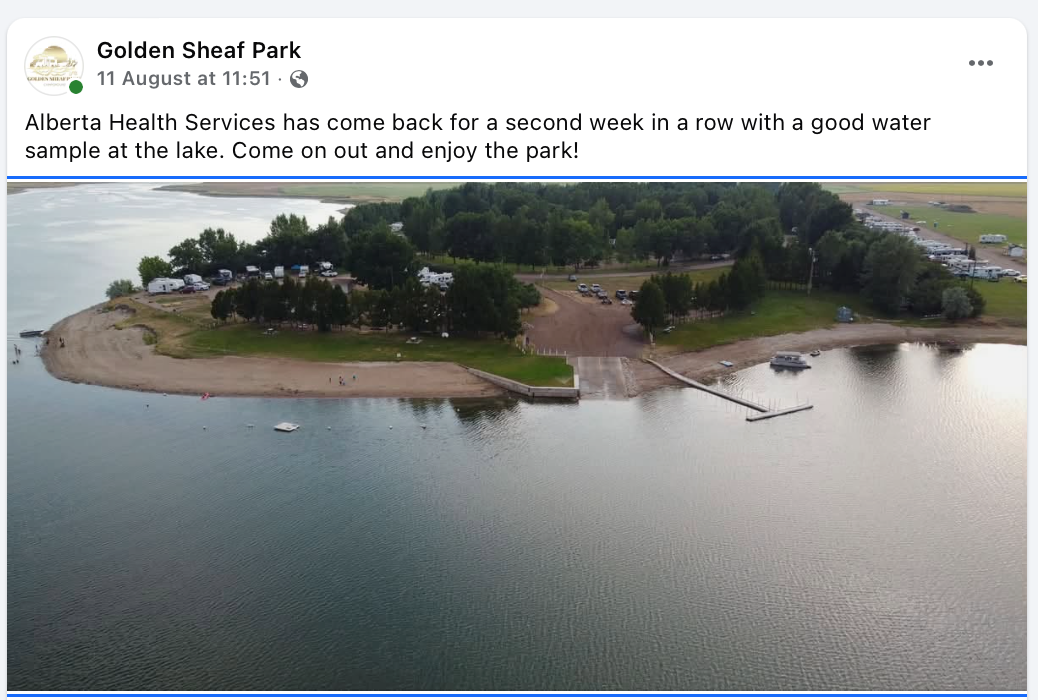
Social media post in question - Golden Sheaf Park FB Page August 11 2026
Alberta Health Services clarifies the water quality advisory is still active.
Medicine Hat, AB – Contrary to speculation circulating on social media, the water quality advisory for Golden Sheaf Park Beach has not been lifted. The Owl reached out to Alberta Health Services (AHS) who have confirmed that the advisory remains in place as officials continue to monitor the situation.
On August 11 Golden Sheaf Park posted on social media, stating,
“Alberta Health Services has come back for a second week in a row with a good water sample at the lake. Come on out and enjoy the park.”
This led many residents to believe that the health risk had passed and the advisory was officially over.
An AHS spokesperson says “The health advisory for Golden Sheaf Park Beach remains in place at this time. Alberta Health Services Environmental Public Health (AHS EPH) continues to monitor water quality at Golden Sheaf Park and are waiting for additional sampling to ensure the conditions that may have contributed to the elevated levels have improved.”
AHS stated that the advisory will only be officially lifted when it is safe to do so. “Once the advisory has been lifted, a rescind advisory will be issued and the active health advisory will be removed from the website,” the statement confirmed.
The initial advisory was issued on July 24 due to elevated levels of bacteria detected in the lake water at the beach . AHS warned the public at the time that swimming or wading could pose health risks, including gastrointestinal illness from ingestion, as well as potential skin, ear, and eye infections from contact with the water.
Officials are reminding the public not to drink or cook with untreated water from the lake and to continue avoiding swimming or wading until the advisory is formally lifted.
A Shallow Lake, A Bigger Problem
Rattlesnake Lake, also known as Sauder Reservoir, is a relatively shallow body of water with a mean depth of just 3.6 metres (11.8 feet) despite spanning 10.7 square kilometres (4.1 square miles).
That shallowness plays a significant role in water quality. Shallow lakes warm up faster and hold heat longer, creating ideal conditions for bacteria to multiply during hot weather - exactly the conditions that triggered the initial advisory. They're also more easily stirred up by wind, which can resuspend bacteria that have settled on the bottom. Additionally, rain and runoff can have a more noticeable impact on a shallow lake because there's less overall water volume to dilute contaminants.
With 9.9 kilometres (6.15 miles) of shoreline providing ample habitat for geese and other waterfowl, the lake is particularly vulnerable to recurring bacteria introduction from wildlife waste.
Previous Article
Golden Sheaf Park Beach Water Advisory: Open, But Swim At Your Own Risk
