

Medicine Hat's Proposed Urban Chicken Bylaw
The Development & Infrastructure Committee is sending the Urban Hens Pilot Program to full Council - likely at the September 21 meeting - where they can accept it, reject it, or send it back for more tinkering.
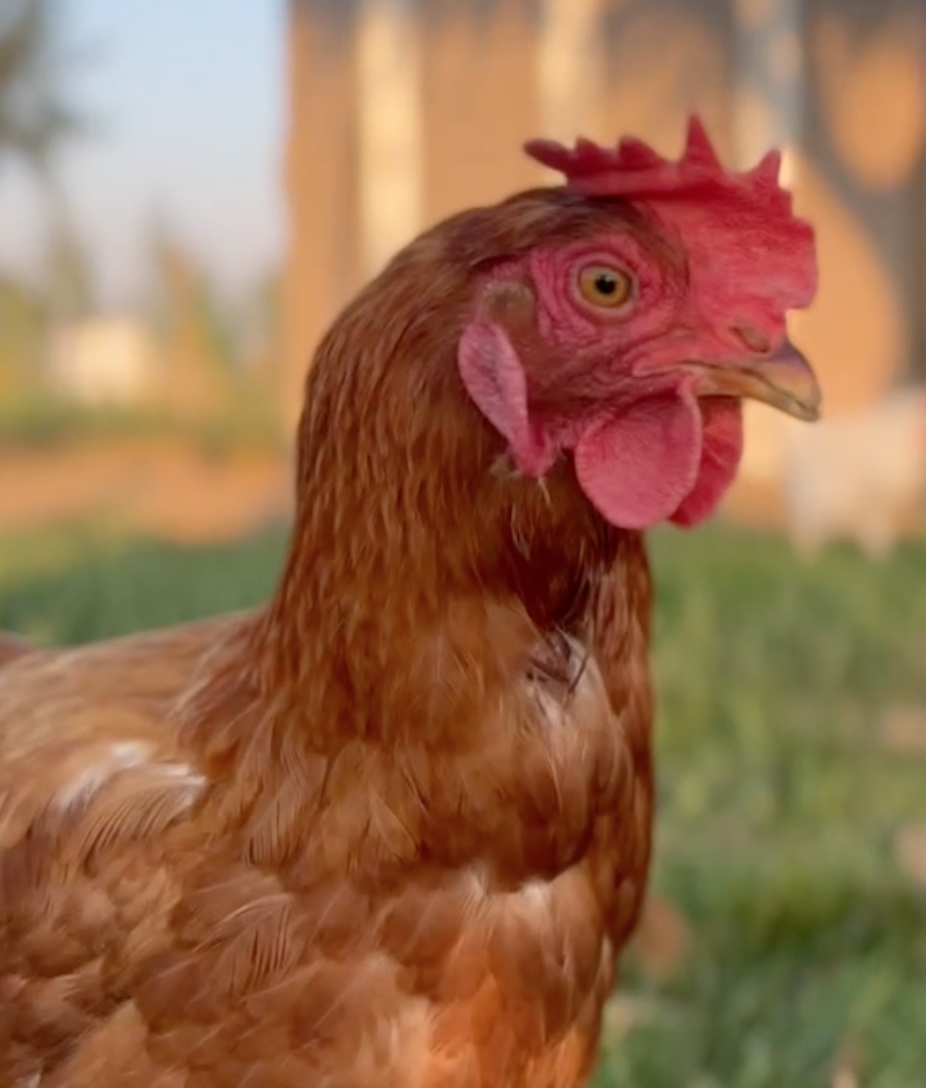
File photo Owl News
The $200,000 Question
Councillor Phaff looked at the numbers and balked. One implementation option included hiring an additional Community Peace Officer (CPO) at roughly $200,000 per year - salary, benefits, vehicle, equipment, and training.
Staff's response: you can't hire one-tenth of an officer. If the program requires more enforcement capacity, they'll need to hire a full officer or reallocate existing resources. The current seven bylaw officers already handle about 8,000 calls per year.
Staff did present a much more economical option - using the resources they already have.
The Drawing Solution
Committee members landed on a sensible idea: instead of sending bylaw officers to inspect every coop before issuing a license, letting applicants submit a drawing of their proposed coop for approval. If a neighbour complains, send someone out.
The Reasonable Stuff
Much of the proposed program makes sense:
No roosters. Loud, unnecessary for egg production.
Predator-proof coops. Medicine Hat has coyotes, foxes, raccoons, and curious dogs.
Cleanliness standards. Nobody wants to smell a neighbour's coop.
The minimum of two hens. Hens are social animals. A single hen suffers without companions.
Licensing and registration. The Provincial Premises Identification requirement is mandated by the Alberta Animal Health Act. Council has no choice.
A seasonal coop for apprehended hens. A suggestion at the committee was a custom option - not one of the four officially presented - that would create seasonal housing for seized hens at a very low capital cost. A seasonal coop keeps costs down and keeps seized hens away from the other animals at Animal Pound Services, reducing disease transmission risks to dogs and cats.
For context - Calgary apprehends about 70 hens in an entire year.
The Questionable Stuff
The Bylaw That Keeps Growing
Advocates asked for simple changes: remove chickens from the livestock definition. Include the reasonable conditions - no roosters, keep them clean, keep them secure. Advocates say it comes down to being a good neighbour.
Roughly 30 people already do this in Medicine Hat - it flies under the radar.
To be fair, staff did a jurisdictional scan (because Council always wants one). They did what Council asked and ended up with a complicated bylaw amendment.
It's the same pattern as trap-neuter-return for community cats. Council wanted to make sure feral cats would be cared for properly - a worthy goal - but they went overboard. The resulting bylaw was so over-engineered it became practically useless.
The Manure Math
The bylaw limits manure storage to 0.1 cubic metres at any time. A single hen produces roughly 0.086 kg of manure per day - about 31 kg per year. For four hens, that's about 124 kg annually.
0.1 cubic metres is 100 litres. That's about three large garbage bags, or roughly two to three weeks' worth of manure from four hens.
Dogs produce far more waste than chicken when you include their urine output. Their waste is not compostable like chicken manure because dogs are carnivores.
Our city allows for 3 dogs per household, regardless of size. Here is a comparison of their waste output.
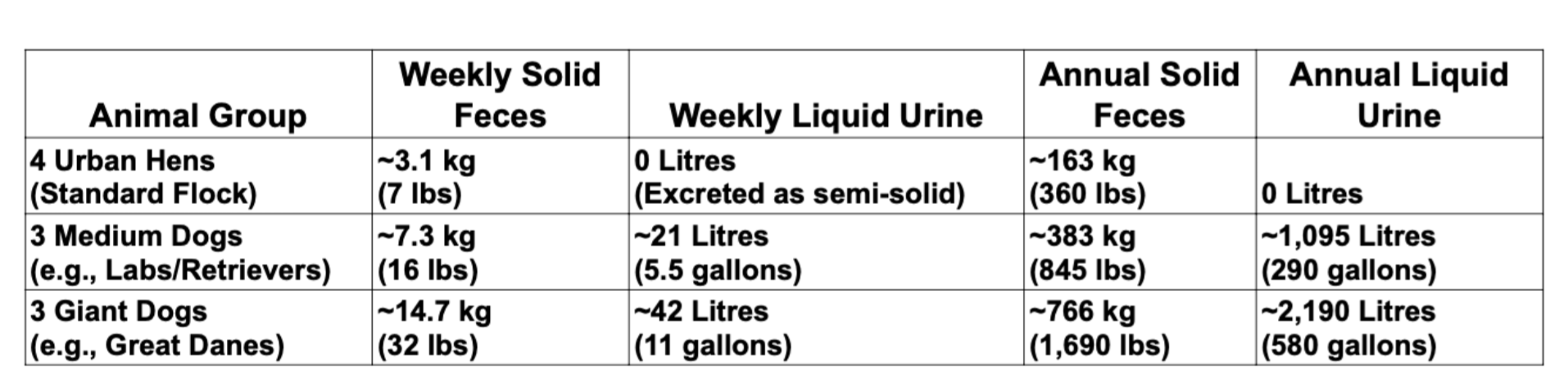
Created by Owl News Sept 9 2026
Everyone In The House Is Responsible
Every occupant of a property where hens are kept is jointly and severally responsible for compliance. If your roommate's hen escapes, you're liable. If your teenager forgets to lock the coop, that's your problem too.
The City does not do this for licensed dogs or cats. If your neighbour's dog barks all night, bylaw goes after the owner - not the whole household.
The Pigeon Problem
Medicine Hat has people who keep racing and homing pigeons, sometimes dozens of them. The Responsible Animal Ownership Bylaw defines "Livestock" to include "animal of the avian species including a chicken, turkey, duck, goose or pheasant."
Pigeons aren't on the list.
So if you want to keep 50 pigeons, there are no rules.
No licence requirements.
No capacity limits.
No mandatory coops or setbacks.
No neighbour notification.
No Provincial Premises Identification.
No inspection requirements.
The Pets Next Door
If someone wants 3 dogs (maximum allowable), they don't need to notify the neighbours. If they want to breed their dogs (puppies under 6 months do not count towards maximum allowable dogs), they do not have to notify the neighbours.
But four hens quietly clucking in a coop? Gotta notify the neighbours.
Under this proposed bylaw the city will notify your neighbours if you are granted an urban hen license. And your neighbour can appeal the granting of your urban hen licence if the keeping of hens is likely to have a material adverse effect on their health.
However, the term "material adverse effect" is not defined. Advocates warn this effectively hands a veto to any disgruntled neighbour. Without strict parameters requiring objective medical evidence, the clause could be used to target hen owners over subjective complaints. Vague health claims - ranging from phantom odour nausea to exaggerated chicken phobias - could be used by risk-averse city staff to revoke licences simply to quiet a neighbourhood dispute.
No such avenue allows neighbours to complain about their neighbour's animal which results in revocation of a licence.
Who Are We Really Serving Here?
The report estimates 279 respondents are "likely or very likely" to participate. But keeping hens is not cheap. A proper coop can run hundreds to thousands of dollars. Feed, bedding, heat lamps in winter - it adds up.
This is not a program for low-income residents looking to offset grocery costs. This is a program for people with disposable income and a backyard.
Of course there are other benefits of keeping chickens, some find the clucking soothing, the manure is useful (after composting) and they are often considered to be pets.
The Bottom Line
Urban hens may be coming to Medicine Hat. The committee is sending it to full Council - likely September 21 - where they can accept it, reject it, or send it back for more tinkering. The pilot program would launch in 2027.
📊 SIDEBAR: The Urban Waste Profile
When cities debate urban hens, waste is always a central argument. But how does a backyard bird truly compare to the pets already roaming our neighborhoods? Here is how a single chicken, a medium dog, and a roaming cat stack up across a year of environmental impact.
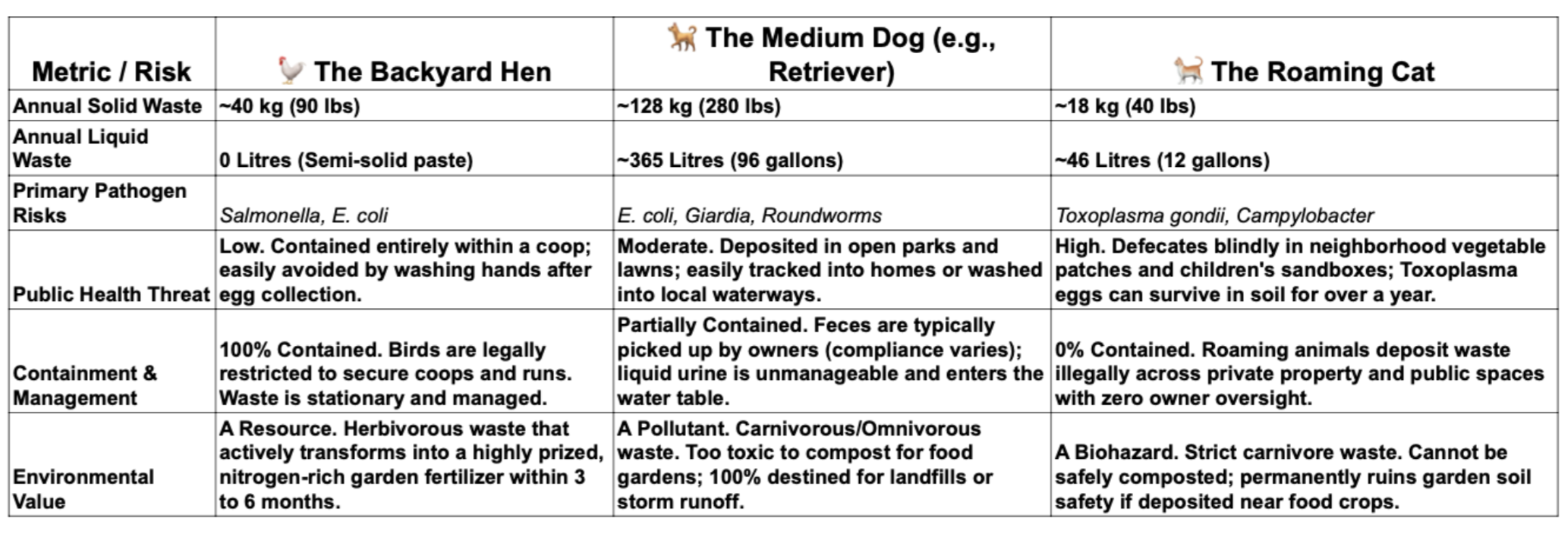
Created by Owl News Sept 9 2026
